

Introduction
That small brownish ring on your bedroom ceiling? It probably didn’t appear overnight. Roof leaks in London homes are notorious for creeping up slowly — weeks, sometimes months of quiet water ingress — before they announce themselves with a dramatic drip or a full-blown damp wall.
Recognising the roof leak warning signs early is the single most effective thing a London homeowner can do to protect their property. Given the city’s relentless rainfall, ageing Victorian housing stock, and the particular vulnerabilities of terraced and flat-roofed homes, the stakes here are genuinely high. A repair that costs a few hundred pounds today can balloon into thousands if ignored.
This guide walks you through the seven warning signs that demand your attention — no scare tactics, just the practical knowledge that seasoned roofers across London see playing out on the ground every day.
Why London Homes Are Especially Vulnerable to Roof Leaks {#why-london}
London averages around 600mm of rainfall per year, spread across nearly 150 rainy days. That persistent dampness, combined with the freeze-thaw cycles of winter and the intense UV of occasional summer heatwaves, puts roofing materials under constant stress.
Then there’s the housing stock itself. A huge proportion of London’s homes — particularly across Hackney, Islington, Lewisham, Hammersmith, and Lambeth — are Victorian or Edwardian terraces. These properties were built with lead flashings, clay tiles, and lime mortar that, a century or more on, are well past their designed lifespan. Parapet walls, chimney stacks, and the valleys between pitched roofs are all classic weak points.
Flat-roofed extensions — incredibly common across south and east London — add another layer of risk. Flat roofs pond water easily and deteriorate faster than pitched alternatives.
Understanding your property type matters enormously when it comes to spotting problems early.
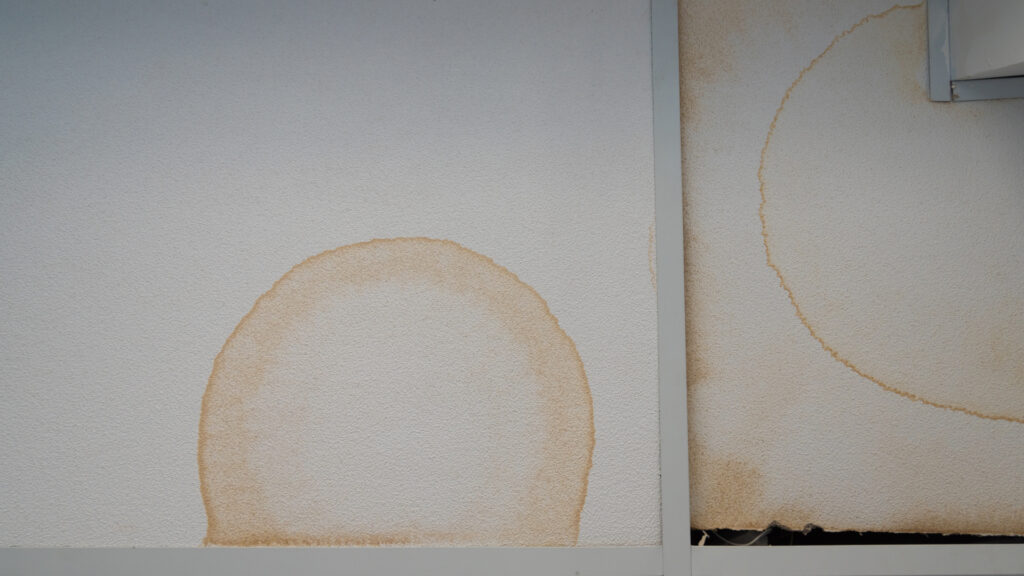
Warning Sign #1 — Brown or Yellow Ceiling Stains {#sign-1}
This is almost always the first visible clue of a roof leak, and it’s one that homeowners frequently ignore or paint over.
Yellow-brown rings, often with a darker outer edge, form when water seeps through the roof structure, travels along joists or insulation, and drips onto the plasterboard below. The stain marks the boundary of where the water spread and dried.
The important thing to understand: the stain rarely appears directly below the entry point. Water travels. If you see staining near a chimney breast — extremely common in London terraces — the actual breach could be the lead flashing around the chimney stack itself, even if the stain appears several feet away.
London-specific note: In terraced houses with shared party walls, ceiling stains sometimes stem from a neighbour’s roof drainage problem rather than your own roof. This is a roof leak warning signs always check both sides before assuming the source.
If you paint over a stain and it reappears within weeks, that is a near-certain indicator of active water ingress. Do not ignore it.
Warning Sign #2 — Damp Patches on Interior Walls (Especially Upper Floors) {#sign-2}
Damp patches on upper-floor walls, particularly where the wall meets the ceiling, are a strong indicator of water ingress from above.
In London’s Victorian terraces, one particularly common culprit is the parapet wall — the section of brickwork that stands proud of the roof line between properties. When the lead flashing or pointing around a parapet deteriorates, rainwater tracks down the inner face of the wall, appearing as spreading damp patches on the interior plaster.
These patches often feel cold and slightly soft to the touch. In autumn and winter, they may worsen noticeably after heavy rainfall and partially dry out during dry spells — that cyclical pattern is a telltale sign the problem is weather-related rather than a plumbing issue.
Don’t confuse this with rising damp (which appears at ground level) or condensation (which tends to be more widespread). Upper-floor damp that tracks along the wall-ceiling junction almost always points upward.

Warning Sign #3 — Peeling Paint or Bubbling Wallpaper {#sign-3}
Paint that blisters, wallpaper that lifts at the seams, or plaster that feels spongy under your fingertips — these are all signs that moisture has been accumulating behind your walls or beneath your ceiling for some time.
This sign is particularly easy to dismiss as “just old decorating” in London’s older housing stock, where many properties carry layers of paint going back decades. But peeling paint that is localised to upper walls or ceilings is rarely a cosmetic issue.
By the time you can see the surface effects, moisture has usually been present for weeks. That means timber rafters, joists, and roof battens may already be showing early signs of decay. The longer you leave it, the more the repair scope grows.
Quick test: Press gently on a bubbling area. If the surface gives under pressure or feels damp, get a roofer up to inspect — sooner rather than later.
Warning Sign #4 — Mould or Mildew Near the Roofline or in the Loft {#sign-4}
Black mould — particularly the type that appears in corners, around loft hatches, or along the upper edges of bedroom walls — is one of the more serious roof leak warning signs in London homes, and not just for structural reasons.
Mould requires sustained moisture to grow. Its presence near the roofline suggests that water has been infiltrating long enough to create the damp, warm environment that spores need. In London’s poorly ventilated Victorian loft spaces, this can happen surprisingly quickly.
Health implications are real. Black mould produces spores that aggravate asthma, trigger allergic reactions, and cause respiratory issues — particularly in children and elderly residents. Local authorities in boroughs like Southwark, Tower Hamlets, and Lewisham have issued enforcement notices to landlords over exactly this kind of damp-related mould.
If you have loft access, look for dark staining on the underside of roof timbers and on insulation batts. A musty smell when you open the loft hatch, even without visible mould, is worth investigating.
Warning Sign #5 — Missing, Cracked, or Slipped Roof Tiles or Slates {#sign-5}
This is one of the few signs you can spot from the street — if you know what you’re looking for.
Stand across the road from your house and look at the roofline. Are all the tiles sitting flush and level? Are there any visible gaps, cracked tiles, or tiles that appear to have slipped out of alignment? In London, where the original clay or Welsh slate roofing on Victorian homes can be 100+ years old, tile displacement is common — especially after strong winds or prolonged frost.
A single missing tile creates a direct pathway for rainwater into the roof structure. Worse, once the underfelt (the secondary waterproof membrane beneath the tiles) degrades — as it inevitably does in older London roofs — there’s nothing to stop that water reaching the timbers.
Chimney flashings deserve special mention. Lead flashing around chimney stacks and where the roof meets a dormer or parapet wall is a notorious weak point. Cracked or lifting flashing causes some of the most persistent and baffling leaks because water enters at one point and appears somewhere entirely different inside.
Warning Sign #6 — Blocked or Overflowing Gutters and Downpipes {#sign-6}
This one gets overlooked far more often than it should.
When gutters block with leaves, moss, and debris — extremely common in London’s tree-lined streets — rainwater backs up and overflows. That overflow doesn’t just run down your external walls; it can work its way under the roof edge, saturating the fascia board, soaking the roofing felt, and gradually working inward.
Signs to look for:
- Water spilling over gutter edges during rain
- Staining or green algae on external brickwork directly below the gutterline
- Damp patches inside, on the walls immediately below the eaves
- Plants or moss visibly growing from gutters (yes, it happens regularly in London)
London properties with mature street trees — common across Kensington, Richmond, Dulwich, and Muswell Hill — are particularly vulnerable to seasonal gutter blockage. An autumn clearance and a spring check should be a non-negotiable part of any London homeowner’s maintenance calendar.
Downpipes that have cracked, pulled away from the wall, or that drain to blocked gulley traps can create similar problems at ground level and along the base of your external walls.
Warning Sign #7 — A Sagging or Bowing Ceiling {#sign-7}
This is the most urgent of all seven signs. If your ceiling is visibly sagging, bowing downward, or has developed a pronounced curve — stop reading and call a roofer immediately.
A sagging ceiling means that water has been accumulating in the roof structure above for long enough to saturate and weaken the plasterboard or lath-and-plaster beneath it. In older London properties, lath-and-plaster ceilings are particularly vulnerable: once the keys that bond plaster to lath become saturated and break down, sections of ceiling can drop without further warning.
This is both a structural emergency and a safety risk. The weight of pooled water above a compromised ceiling can be considerable — and it doesn’t give much notice before it comes down.
If you press gently on a sagging area and feel water movement above it, or if water drips from the lowest point of the sag, evacuate the room of furniture and valuables and get professional assessment that day.
What To Do If You Spot These Signs {#what-to-do}
1. Document everything. Take photos and note when stains appeared or worsened. This matters for insurance claims.
2. Check your home insurance policy. Many standard policies cover sudden and accidental water damage, but gradual deterioration may be excluded. Checking before you call a roofer gives you a clearer picture of your position.
3. Get a professional inspection — not a quote. A reputable London roofer should assess the roof before pricing repairs. Be cautious of anyone who quotes without getting up there to look.
4. Don’t just paint over it. Surface treatment doesn’t fix structural water ingress. It delays diagnosis and usually makes the eventual repair more expensive.
5. Act before winter. London roofing contractors are significantly busier from October through February. Addressing issues in late summer or early autumn typically means faster response times and better availability.
Frequently Asked Questions {#faqs}
How do I know if my roof is leaking or if it’s condensation? Condensation tends to be widespread — appearing on cold surfaces like window glass, external walls, and ceilings throughout the home, especially in winter. Roof leak damage is typically more localised: appearing near the roofline, chimney breasts, or below roof valleys, and often worsening during or after rainfall specifically.
How much does roof leak repair cost in London? Minor repairs — reseating a few slipped tiles or re-bedding chimney flashing — typically range from £150 to £500 in London. More complex work involving re-laying sections of flat roof, replacing valley linings, or repairing structural timber can run from £1,000 to £5,000+. Getting two or three quotes from NFRC-registered contractors is always recommended.
Can I fix a roof leak myself? Small tasks like clearing blocked gutters are safe DIY jobs. Actual roofwork — getting on the roof, working around tiles, flashings, or membranes — carries serious fall risks and requires professional training and appropriate safety equipment. In most cases, attempting DIY roof repairs also invalidates any warranty on existing roofing materials.
How quickly does a roof leak cause damage? Active water ingress can begin to cause timber decay and mould growth within weeks in London’s damp climate. A small, slow leak that goes unnoticed for a season can cause rot in roof joists and insulation degradation that dramatically increases repair costs. Early detection is always cheaper.
Is a leaking roof covered by home insurance in the UK? It depends on the cause and policy wording. Sudden storm damage is typically covered. Gradual deterioration due to wear and neglect usually is not. If your roof hasn’t had documented maintenance, insurers may challenge a claim. A professional inspection report can strengthen your position significantly.
Should I be worried about a small ceiling stain? Yes — but don’t panic. A small stain is worth investigating promptly, not urgently. Monitor whether it grows, darkens, or worsens after rain. If it does, or if it reappears after redecoration, treat it as an active problem and book a roof inspection.
Conclusion {#conclusion}
Roof leaks rarely announce themselves dramatically. They whisper first — a yellow ring on the ceiling, a patch of damp that comes and goes, a faint mustiness from the loft. By the time they’re shouting, the damage is usually well established and the repair bill significantly higher.
If you live in a London terrace, a flat-fronted Victorian townhouse, or a property with a flat-roofed extension, the specific vulnerabilities described in this guide apply directly to your home. The city’s weather, its ageing housing stock, and the structural quirks of period properties all combine to make roof leak warning signs worth taking seriously — quickly.
A proactive inspection, ideally once a year and always after a period of severe weather, is the single most cost-effective thing you can do. Paired with keeping gutters clear and being alert to interior changes, it puts you firmly in control rather than waiting for a crisis to force your hand.
If you’ve spotted any of the warning signs above in your London home, don’t wait for them to get worse. Get a professional eye on it — the sooner the better.
Internal Link Suggestions
- Link to: “How Much Does Roof Repair Cost in London? A Complete 2026 Guide“
- Link to: “Flat Roof vs Pitched Roof — Which Is Right for Your London Extension?”
External Authority Links
- National Federation of Roofing Contractors (NFRC) — Find registered, vetted roofers in London and verify contractor credentials
- The Building Research Establishment (BRE) — Roof Maintenance Guidance — Independent technical guidance on UK roof construction and defects
- Association of British Insurers — Home Insurance Water Damage — Understand your home insurance rights for water ingress claims
- Historic England — Maintenance of Traditional Roofs — Particularly relevant for owners of listed buildings or properties in London conservation areas