If your flat roof is leaking or past its best, you’ll quickly hear two names: GRP (fibreglass) and EPDM (rubber). Every installer seems to have a favourite, and every favourite seems to be the one they sell. That’s not much help when you’re spending thousands of pounds.
We’ve fitted both systems across London since 1982, so here’s an honest comparison of GRP vs EPDM — how they work, what they cost, how long they last, and which one suits your home.
What is a GRP (fibreglass) flat roof?
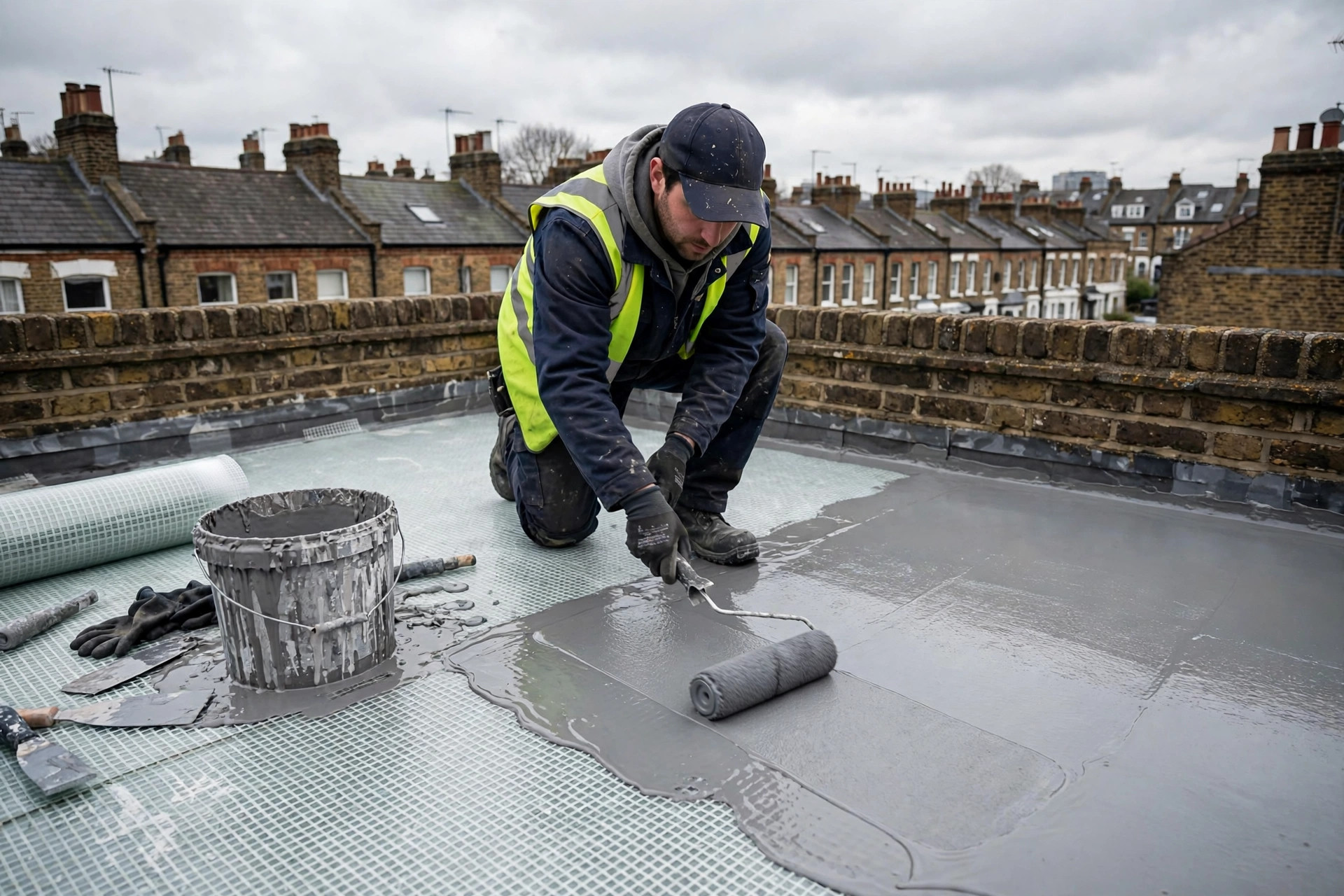
GRP stands for glass-reinforced plastic. In practice, a roofer lays fibreglass matting over your roof deck, then saturates it with resin and finishes with a topcoat. It cures into a rigid, seamless shell — essentially a hard plastic skin over your roof.
Because it’s built up in liquid form on site, GRP copes well with awkward shapes, small upstands, and detailing around skylights. A good GRP roof looks tidy and feels rock-solid underfoot, which matters if you ever need to walk on it for maintenance.
What is an EPDM (rubber) flat roof?
EPDM is a synthetic rubber membrane — one big flexible sheet, usually from brands like Firestone. It’s laid over the deck, glued down (fully adhered) or mechanically fixed, with seams sealed using special tape or adhesive.
Its big selling point is simplicity: fewer seams, no wet trades, no curing time. A straightforward domestic flat roof can often be done in a day. The membrane is flexible, so it handles a bit of building movement without cracking.
GRP vs EPDM: cost comparison
For a typical single garage or small extension roof (around 20–30m²), realistic 2026 London price bands look like this:
- EPDM: roughly £1,800–£3,200 fully installed
- GRP: roughly £2,200–£3,800 fully installed
EPDM usually comes in cheaper on labour because it’s quicker to lay. GRP costs more because it’s a multi-stage process — matting, resin, topcoat — and it’s weather-sensitive (resin won’t cure properly in the cold or wet, so jobs can be delayed).
Be wary of quotes far below these bands. Cheap GRP is a classic false economy: rushed resin work cures badly and starts bubbling or cracking within a few summers. If you’re comparing quotes, our guide to why roofing quotes vary explains what to watch for.
Lifespan: how long does each last?
- EPDM: 30–50 years is realistic for a quality membrane, properly installed. The rubber itself doesn’t rot or crack with age; failures almost always come from bad seams or poor detailing at edges.
- GRP: 20–30 years when done well. The weak points are stress cracking over time and damage from thermal movement — the rigid shell expands and contracts, and if the deck moves underneath, cracks follow.
This is the area where installer skill matters most. A badly laid EPDM roof leaks at the seams within a year; a badly laid GRP roof bubbles and cracks within two. The material matters less than the hands fitting it, which is why guarantees are only worth what the company behind them is worth.
Durability: foot traffic, punctures and weather
Foot traffic: GRP wins here. Its rigid surface shrugs off occasional foot traffic, ladders, and satellite-dish installers. EPDM is tough rubber, but sharp objects, dropped tools, and claws can puncture it — worth considering if you have cats that treat the roof as a shortcut.
Weather: EPDM handles UK weather calmly — rain, frost, and sun don’t bother it much, and it’s quiet in all of them. GRP can be noisy: some homeowners report cracking or popping sounds as the shell expands and contracts with temperature swings, especially on a cold deck.
Ponding water: Neither system likes standing water forever, though EPDM tolerates it better than GRP. If your roof holds puddles for days after rain, read our guide to flat roof ponding water — the drainage issue matters more than the material choice.
Installation: speed, mess and disruption
EPDM is the cleaner, faster job: one membrane, one day for most domestic roofs, minimal smell. GRP involves resin fumes (strong, though they disperse), several curing stages, and dry weather — a realistic install takes two to three days, and a rainy week can push it back.
If you’re on a tight timescale — say, a leak that needs sorting before winter — EPDM’s speed is a genuine advantage.
Aesthetics: what does each look like?
EPDM is almost always black, with a slightly textured rubber finish. It looks neat and modern, but it is unmistakably a rubber roof. GRP’s topcoat comes in colours — most commonly grey — and gives a smoother, more “finished” look that some homeowners prefer, especially on visible extension roofs.
So which is better: GRP or EPDM?
Honest answer: it depends on the roof.
- Choose EPDM for straightforward rectangular roofs, tight budgets, fast turnarounds, and situations where flexibility matters (older buildings that move a little).
- Choose GRP for complex shapes with lots of detailing, roofs that get walked on, and where you want a coloured, hard-wearing finish.
What we’d never do is recommend either system without looking at the deck underneath. A surprising number of flat roof problems — leaks, ponding, noise — come from a rotten or uneven deck, not the waterproofing on top. A proper survey catches that before you spend a penny.
If you’d like a fuller breakdown of the rubber option specifically, see our EPDM rubber roofing pros and cons guide.
Need a flat roof in London?
Victoria Roofing Expert Ltd has been fitting and repairing flat roofs across Camden and all of London since 1982 — family-run, 5.0 from 338 Google reviews, and open 24 hours for emergencies. We fit both GRP and EPDM and will tell you straight which suits your roof.
For repairs to an existing flat roof, see our flat roof repair in London page, or our roof installation page for full replacements. Get a free quote — no obligation, no pressure, just an honest assessment and a fair price.