
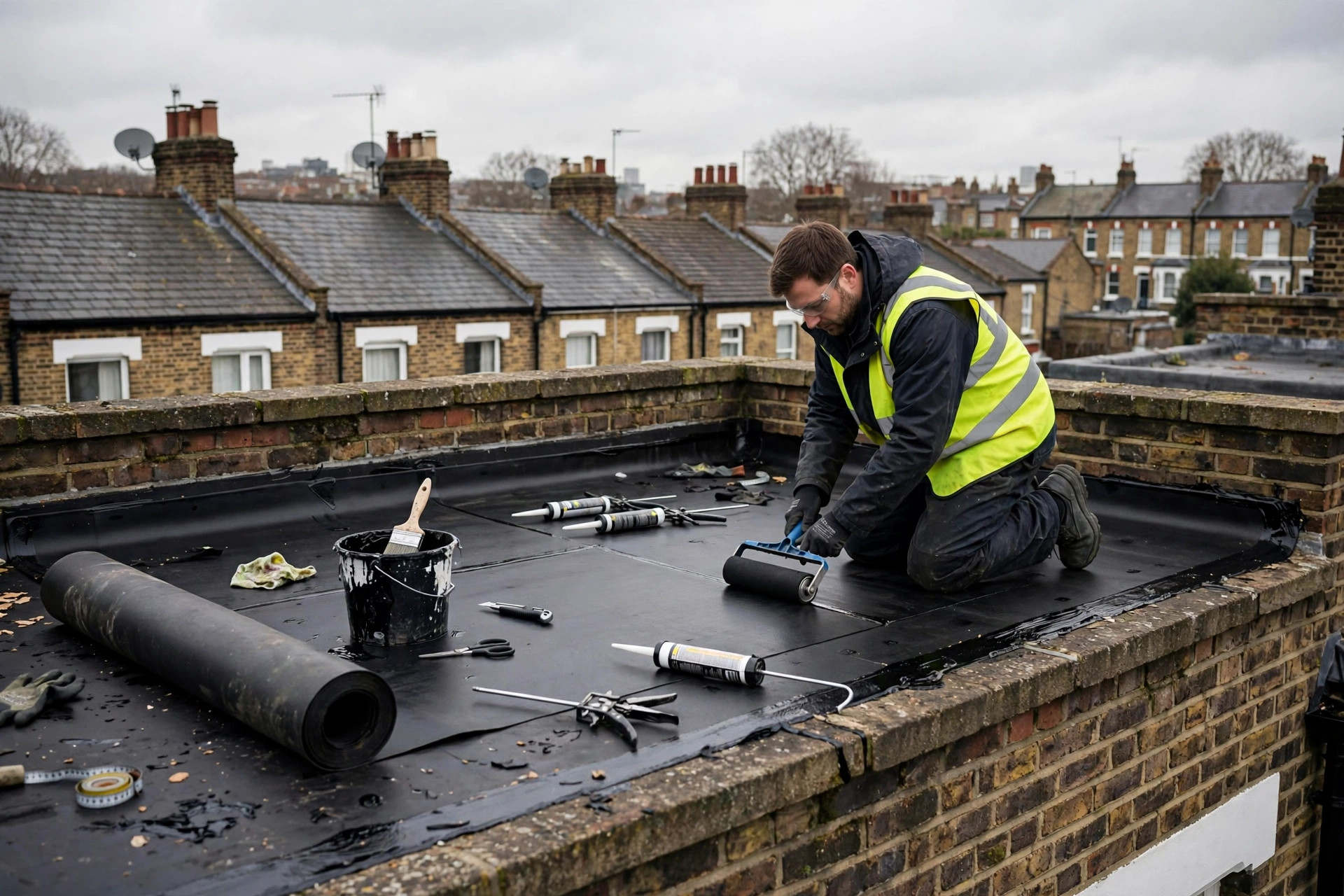
If your flat roof has reached the end of its life — blistering felt, persistent ponding, leaks that keep coming back after repairs — you’re probably wondering what a full replacement actually costs in 2026. The honest answer is that it depends on the material, the size, and what’s underneath. This guide gives you realistic price bands so you can spot a fair quote and recognise one that isn’t.
How much does flat roof replacement cost per m2 in 2026?
As a rough starting point, most London homeowners pay the following installed rates for a full strip-and-replace, including labour, materials and waste disposal:
- Torch-on felt (2–3 layer): £60–£95 per m2
- EPDM rubber: £75–£110 per m2
- GRP fibreglass: £85–£120 per m2
- Single-ply PVC membrane: £90–£130 per m2
- Liquid-applied systems: £80–£115 per m2
London prices sit toward the top of these bands because of higher labour costs, access challenges and parking, but the figures above are realistic for a competent contractor doing a proper job — stripping the old covering, replacing rotten decking, and fitting new trims and outlets.
Typical total prices by roof size
- Single garage flat roof (15–20 m2): £1,500–£3,000
- Rear extension (20–30 m2): £2,500–£4,500
- Larger extension or dormer (40–60 m2): £4,500–£7,500
- Full terraced-house flat roof or big commercial-style deck (60 m2+): £7,500+
These are full replacements, not overlays. An overlay — laying a new membrane over the old covering — can cost 20–30% less, but it only works if the deck underneath is sound and the old covering is firmly bonded. If the deck is rotten, an overlay is money wasted.
What affects your final price?
Two quotes for the same roof can differ by thousands, and usually there’s a reason. These are the factors that move the price:
Roof size and shape. Larger areas bring the per-m2 rate down, but awkward shapes, upstands, rooflights and pipe penetrations add labour.
The material system. EPDM and GRP cost more in materials than felt but last considerably longer — see the lifespan section below.
Decking condition. If the timber decking underneath is soft or rotten, it has to come out. New OSB decking typically adds £25–£45 per m2.
Insulation — warm deck vs cold deck. Building regulations generally require insulation when you renew a flat roof. A warm-deck build-up (insulation above the deck) adds roughly £30–£60 per m2 but stops condensation and makes the roof perform properly. If your current roof is a cold deck with no insulation, expect this to be part of the quote.
Edge details, outlets and leadwork. Drip edges, upstands, gutter outlets and any lead flashing to adjoining walls are skilled work. Cheap quotes often skimp here — and these are exactly the details that leak first.
Access and waste. Scaffolding or a tower, plus skip hire and waste disposal, can add several hundred pounds in London, especially on properties where access is tight.
Felt vs EPDM vs GRP: which system should you choose?
For most domestic flat roofs in London, the choice comes down to these three:
Torch-on felt is the cheapest and most familiar system. Modern high-performance felts are far better than the old single-layer stuff, and a good three-layer system will last 15–20 years. It’s forgiving to install and easy to repair.
EPDM rubber is a single-ply membrane supplied in large sheets, so large roofs can be done with minimal seams. It handles movement well and typically lasts 25–30 years. Our full comparison of GRP vs EPDM goes deeper if you’re deciding between the two.
GRP fibreglass is laid up in place and forms a seamless, rigid skin. It lasts 25–30 years when done properly, but the quality depends heavily on the installer — GRP is less forgiving of poor workmanship than EPDM.
If you want the most durable option with the fewest seams, EPDM is usually the recommendation for straightforward rectangles; GRP suits complex shapes with lots of details.
Repair or replace? How to tell
You don’t always need a full replacement. If your roof is generally sound with one localised issue — a split seam, a damaged outlet — a flat roof repair is the sensible route. Full replacement becomes the right call when:
- The covering is past its expected lifespan and multiple patches have been done
- There are blisters across a large area, not just one spot
- Water is ponding and the falls were never built in properly (flat roof ponding water explains when this matters)
- The decking feels spongy underfoot — that’s rot, and the whole build-up needs to come off
- You’ve had two or more leak repairs in the last couple of years and it’s still leaking
How long does each system last?
As a guide: felt 15–20 years, EPDM 25–30 years, GRP 25–30 years, PVC 25–30 years. Lifespan depends on installation quality as much as the material. A guarantee from the installer is only worth something if the company is established enough to still be around — we’ve been family-run since 1982, which is why we offer fully guaranteed workmanship.
Getting a fair quote
Get two or three written quotes that specify the material system, the build-up (deck, insulation, covering), the edge details and the guarantee. If one quote is dramatically cheaper, check what’s missing — often it’s the insulation, the deck replacement or the leadwork. A proper survey should involve walking the roof and checking the deck, not just measuring from the pavement.
If you’re also thinking about a pitched roof project, see our roof installation page for how full new roofs are priced.
Get a free, no-obligation quote
For an accurate price on your flat roof, there’s no substitute for a survey. We’re a family-run roofing contractor working across Camden and all of London, open 24 hours for emergencies. Request a free quote and we’ll inspect the roof properly and give you a written, itemised price — no pressure, no obligation.