
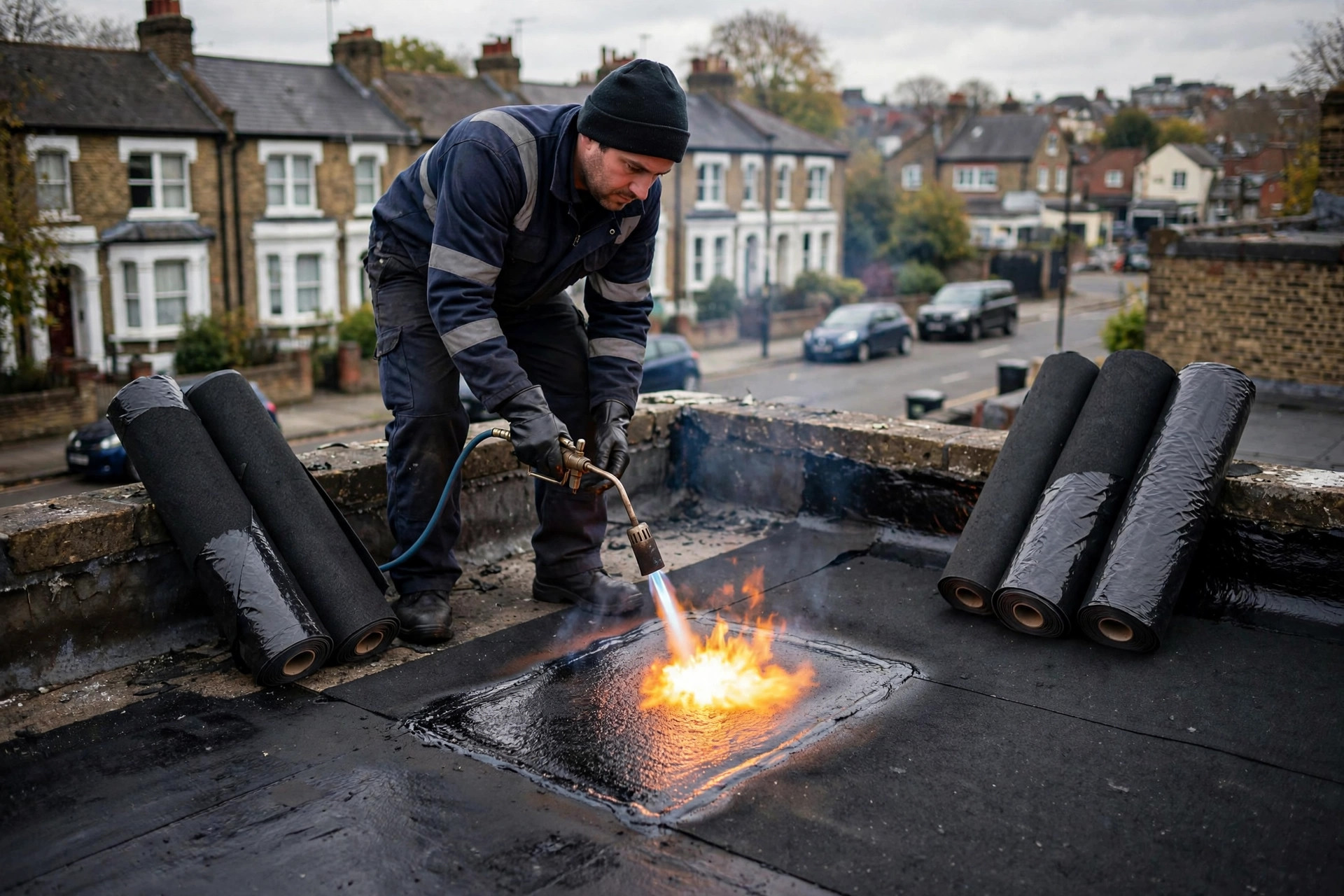
Bitumen felt has been covering British flat roofs for over a century — garages, extensions, sheds, and dormers up and down the country sit under it. If yours is getting on in years, the question isn’t whether it will need replacing, but when.
Here’s how long a felt roof lasts in the UK, what shortens or extends its life, the warning signs to watch for, and what replacement costs in London.
How long does a felt roof last?
It depends on the type of felt and the quality of the installation:
- Traditional pour-and-roll felt (2 layers): 10–15 years. This is the old-school system — still seen on older garages, and the shortest-lived option.
- Torch-on felt (2–3 layers, modern SBS-modified bitumen): 15–25 years. This is the current standard for a proper felt roof, and the only felt system we’d install today.
- High-performance 3-layer torch-on with mineral cap sheet: 20–30 years at the top end, when laid on a sound deck by a competent roofer.
So the honest answer to “how long does a felt roof last” is: 10 to 25 years, with most decent torch-on roofs landing around the 20-year mark. The spread is almost entirely about installation quality and maintenance — two felt roofs laid the same year can be a decade apart in lifespan.
What shortens a felt roof’s life?
Standing water. Felt’s biggest enemy. Permanent ponding breaks down bitumen far faster than rain that drains away. A felt roof that ponds will die years early.
UV exposure. Sunlight degrades bitumen. Mineral cap sheets protect against this — a felt roof without a proper cap layer ages visibly faster. If your felt looks grey, powdery, or you can see the bitumen going shiny and brittle, UV is winning.
Poor installation. Cold laps (joints not properly bonded), felt laid on a damp deck, inadequate upstands at edges — installation defects are the difference between 25 years and 12. Felt is very installer-dependent.
Foot traffic and damage. Felt punctures and scuffs more easily than GRP or EPDM. One careless satellite-dish installer can halve a roof’s remaining life.
Moss and vegetation. Moss holds moisture against the surface and its roots work into laps and joints. A green felt roof is a roof ageing faster than it should.
The 7 signs your felt roof needs replacing
- Widespread blistering or bubbling — moisture trapped in the layers, and it only spreads.
- Cracks, splits, or crazing across the surface, especially at laps and upstands.
- Bald patches where the mineral finish has worn away, exposing bitumen to UV.
- Ponding that wasn’t there before — the deck is sagging, and the structure needs attention.
- Leaks in more than one place — one leak is a repair; several leaks mean the system is failing.
- The felt feels brittle — if it cracks rather than flexes when you press it (carefully), it’s done.
- It’s over 20 years old and showing any of the above — you’re on borrowed time; plan the replacement rather than waiting for the ceiling to tell you.
A single blister or a small tear at an edge? That’s a repair job — torch-on felt patches well. But when problems are widespread, patching becomes good money after bad.
Repair or replace: the honest maths
A localised felt repair in London typically costs £250–£600. A full replacement of a garage-sized roof runs £2,000–£4,000 depending on size and system.
Our rule of thumb: if repair costs are approaching a third of replacement cost, or if you’d need a third repair within a couple of years, replace it. Also consider what you’d replace it with — many homeowners use a failing felt roof as the moment to upgrade to EPDM, which lasts roughly twice as long. Compare the options in our GRP vs EPDM guide, or read the full EPDM pros and cons.
How to make a felt roof last longer
- Keep gutters and outlets clear so water drains, not ponds.
- Clear moss and debris once a year — a soft brush, not a pressure washer.
- Don’t walk on it unnecessarily, and never drag anything across it.
- Get small damage repaired promptly — a £300 patch now beats a £3,000 replacement later.
- Have it inspected every few years once it passes 15 — catching perished laps early buys real time.
One more habit worth adopting: photograph your roof once a year from the same spot. Dated photos make gradual changes obvious — a ponding area creeping wider, blisters spreading, mineral loss advancing — that you’d otherwise miss month to month. They’re also useful evidence if you ever need to call on a guarantee.
What does felt roof replacement cost in London (2026)?
Realistic bands for a professional torch-on replacement on a sound deck:
- Small porch/dormer (10–15m²): £1,400–£2,200
- Single garage or extension (20–30m²): £2,000–£4,000
- Larger roofs (40m²+): £3,500–£6,500
Add £40–£70 per m² if the deck needs replacing. As ever, quotes far below these bands are a red flag — felt is one of the easiest systems to do badly and one of the hardest to inspect afterwards.
Is your felt roof nearing the end?
Victoria Roofing Expert Ltd has been replacing and repairing felt roofs across Camden and all of London since 1982. Family-run, 5.0 from 338 Google reviews, open 24 hours, workmanship fully guaranteed.
See our flat roof repair in London page for repair options, or get a free quote — we’ll tell you straight whether yours wants a patch or a replacement.