
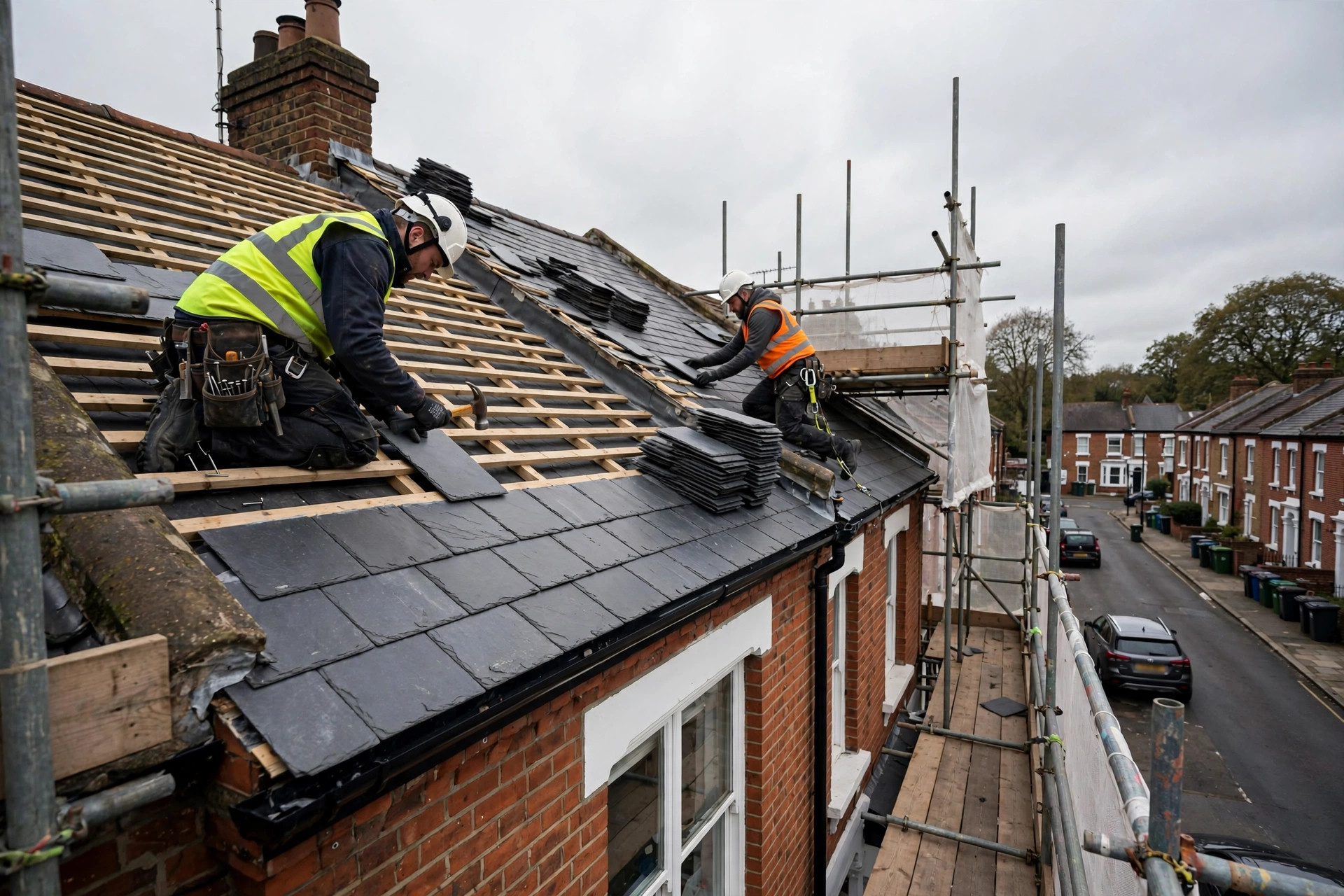
A new roof is one of the biggest jobs you’ll ever do on a house, and quotes can feel like they come from different planets — one roofer says £7,000, another says £18,000, and you’re left wondering who’s telling the truth. The honest answer: both could be right, depending on what’s included. Here’s how new roof costs actually break down in London in 2026.
Average new roof cost in London 2026
For a typical 3-bedroom London home (semi-detached or terraced, roughly 60–90 m2 of roof area), realistic 2026 price bands are:
- Concrete tile roof: £7,500–£13,000
- Slate roof (natural slate): £11,000–£18,000
- Clay plain tile roof: £12,000–£19,000
- Fibre cement slate (lookalike): £8,500–£14,000
A small terraced house with a straightforward roof might come in at the lower end; a detached property with hips, valleys, dormers and a chimney will push toward the upper end. London prices run higher than the national average — labour, scaffolding, parking and waste disposal all cost more here.
Cost per m2: the fairest way to compare quotes
Ask each roofer for their per-m2 rate alongside the total. In London in 2026, fully installed rates (stripping the old roof, new breathable membrane, treated battens, the covering itself, and finishing details) run roughly:
- Concrete tiles: £110–£160 per m2
- Fibre cement slate: £120–£170 per m2
- Natural slate: £160–£230 per m2
- Clay plain tiles: £170–£240 per m2
If a quote works out to far less than these bands, something is being left out — usually the membrane, proper battens, or the leadwork. That missing work is what leaks first.
What’s included in a proper new roof?
A full re-roof isn’t just new tiles. A proper job includes:
- Strip-off and disposal of the old covering, plus a skip
- Inspection of the timbers — rotten rafters and purlins replaced where needed
- Breathable membrane and treated battens to current standards
- The new covering — tiles or slate
- Ridge, hip and verge details — dry-fixed systems are standard now
- Leadwork — flashings, soakers, valleys and chimney lead renewed, not just re-used
- Fascias, soffits and guttering checked and replaced if rotten
This is also why a roof that’s leaking in several places is often cheaper to replace than to keep repairing. Our guide on roof repair vs replacement helps you work out which side of the line you’re on.
What pushes the price up?
Scaffolding. Full perimeter scaffolding for a typical London terrace costs £1,500–£3,000 and is usually included in the quote. Tight access, narrow streets and parking suspensions all add cost.
Roof complexity. Every valley, dormer, chimney and change of pitch adds labour. A simple gabled roof is cheapest per m2; a roof full of features is the opposite.
The existing roof’s condition. Rotten timbers, failed felt and crumbling mortar add carpentry time. You won’t know the full picture until the old roof comes off, so a good quote will state this plainly rather than bury it.
Material choice. Natural slate costs more than twice what concrete tiles do, and clay plain tiles sit near slate prices. The difference isn’t just looks — a slate roof can last a century, while concrete tiles give you 40–50 years.
Structural work. If rafters need sistering or a purlin needs replacing, budget £500–£2,000 on top, depending on extent.
Slate vs tile: which is worth the money?
For London housing stock — especially Victorian terraces — slate suits the original character and lasts 80–100+ years. Concrete tiles are the value option: perfectly good, just heavier and shorter-lived. Clay plain tiles sit between, with a distinctive look that’s popular in conservation areas. If your street is in a conservation area, the council may insist on like-for-like, so check before you choose.
How long will a new roof take?
Roughly: concrete tiles 40–50 years, fibre cement slate 40–50 years, clay tiles 60–80 years, natural slate 80–100+ years. The membrane and battens underneath matter too — a cheap membrane can fail long before the tiles do, which is why we use quality components and back our work with fully guaranteed workmanship.
Red flags in a cheap quote
Be cautious if a quote:
- Doesn’t mention a breathable membrane or new battens
- Re-uses old lead flashings “to save you money”
- Is cash-only with no written guarantee
- Can’t show you photos of previous work or reviews
We’ve been family-run since 1982, and every one of our 338 Google reviews averages 5.0 — that’s the track record you want from someone fitting a roof that should last decades.
How long does a re-roof take?
Most typical London homes take 5–10 working days, weather permitting. Larger or more complex roofs can run to two or three weeks. A decent roofer keeps the roof watertight every night — that means stripping and re-covering in sections, not leaving the whole roof open.
Get a free, no-obligation quote
A fair price starts with a proper inspection — of the roof, the timbers, and the details that will decide the final figure. We’re a family-run roofing contractor at 188 Camden High St, working across Camden and all of London, open 24 hours. See our roof installation service, or request a free quote and we’ll give you a written, itemised price with no pressure.