
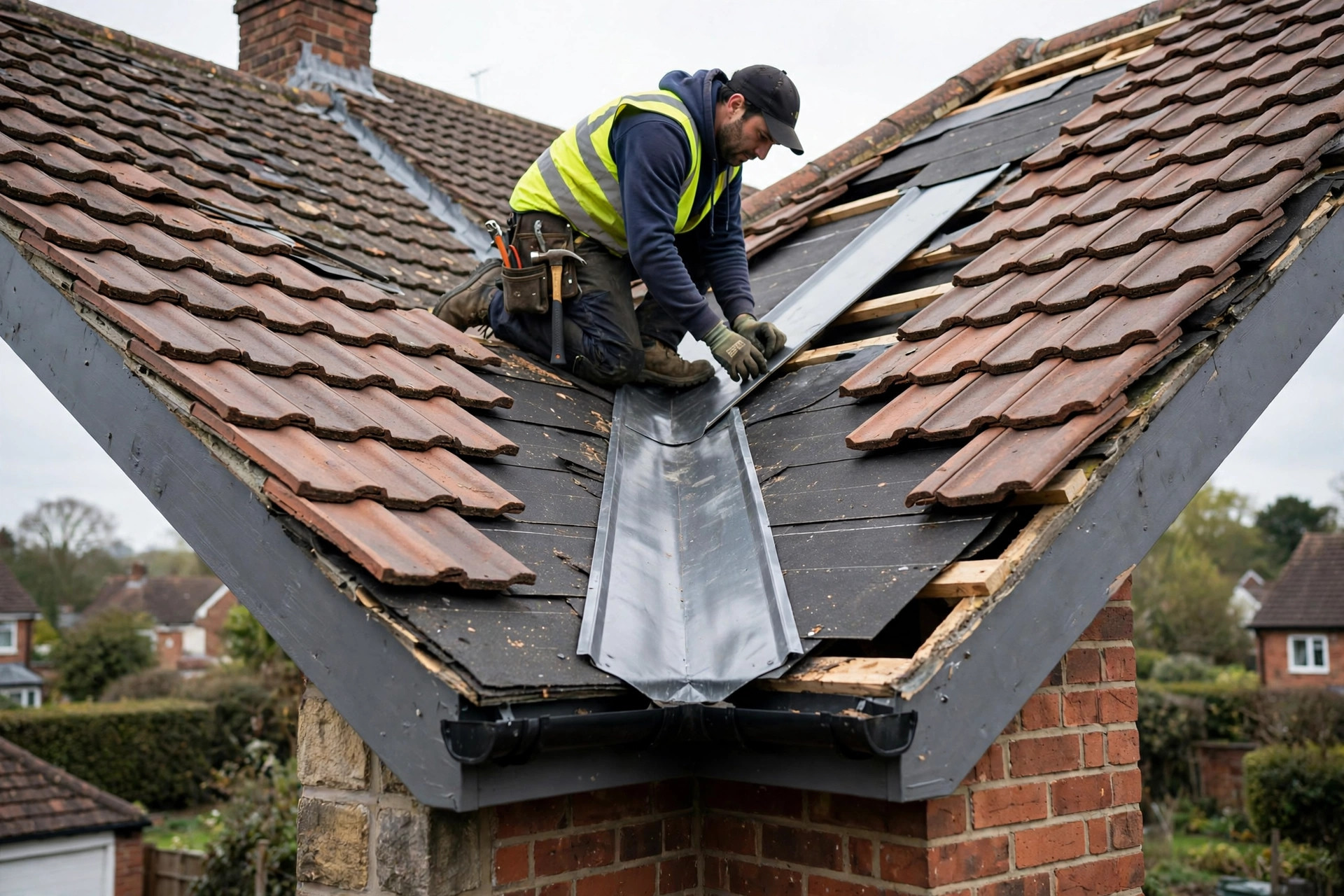
The valley — where two roof slopes meet — carries more water than any other part of your roof. It’s also one of the most common leak locations we deal with in London. If you’ve got damp appearing on a ceiling below where two slopes join, the valley is suspect number one.
Here’s what causes roof valley leaks, how they’re repaired, what it costs, and when a valley problem means looking at the wider roof.
What is a roof valley?
A valley is the internal angle where two pitched roof surfaces meet — typically on L-shaped houses, or where a dormer or extension joins the main roof. Rain from both slopes funnels into it, so it handles a concentrated flow of water. Valleys are usually formed with one of:
- Lead or GRP valley troughs — a shaped channel laid under the tiles/slates
- Tile valleys — special valley tiles
- Mortar-bedded valleys (older roofs) — tiles bedded in mortar, now mostly seen on ageing roofs
What causes valley leaks?
Perished underlay beneath the valley. The most common cause on older roofs. The valley trough itself might be intact, but the felt or membrane underneath has rotted through — and in a valley, “underneath” is exactly where all the water goes. On 1960s–80s roofs with bitumen felt underlay, this is almost expected by now.
Cracked or slipped valley tiles. Valley tiles take the full water flow plus foot-traffic risk during any roof work. A cracked one lets water straight through to the underlay — fine if the underlay’s sound, a leak if it isn’t.
Failed mortar. Old mortar-bedded valleys crack and crumble with age and frost. Once the mortar goes, water tracks underneath the tiles. You’ll often see this as damp patches that grow slowly over months.
Blocked valleys. Leaves, moss, and debris dam up in the valley channel. Water backs up, overflows the trough, and gets under the tiles at the sides. The simplest cause — and the simplest fix.
Corroded lead. Lead valleys last a very long time, but they don’t last forever — 60–100 years depending on thickness and conditions. Splits from thermal movement or thinning from years of water flow eventually let water through.
Poor original detailing. Valleys cut too narrow, troughs with inadequate laps, tiles trimmed badly at the valley edge — installation defects that may have been leaking subtly for years before showing inside.
How to tell it’s the valley
Valley leaks have a signature: damp or staining on the ceiling directly below where two roof slopes meet, often appearing or worsening in heavy rain. In the loft, you may see water staining on the timbers along the valley line, or daylight where there shouldn’t be any.
One complication: water travels. It can run down the underlay from the valley and drip some distance away. That’s why a proper diagnosis means getting up there (or in the loft) and tracing it, not just patching where the stain is. If water is coming through the ceiling, our water coming through ceiling guide covers immediate steps.
Repair options, from minor to major
Clear and inspect (£0–£150). If the valley is blocked with debris, clearing it and checking the condition underneath sometimes resolves the whole thing. Always the first step.
Repoint or re-bed the valley (£400–£800). For mortar-bedded valleys where the tiles and trough are otherwise sound, raking out failed mortar and re-bedding is a solid repair. A proper job, not a smear of sealant over the top.
Replace broken valley tiles (£300–£700). Individual cracked or slipped valley tiles can be replaced, provided the underlay beneath is sound. If the underlay’s gone too, you’re into the next category.
Renew the valley trough and underlay (£900–£1,800). The proper fix for a perished valley: strip the tiles back along both sides, lay a new valley trough (lead or GRP) with new underlay, and re-lay the tiles. This is the repair we do most often, and done properly it lasts decades.
Full re-roof consideration. If the valley underlay has perished, ask what the rest of the underlay looks like — it’s the same age and the same material. A failed valley on a 50-year-old roof is often the first symptom of a roof-wide underlay problem. That’s when our roof repair vs replacement framework applies: fix the valley now by all means, but budget for the bigger job.
What does roof valley leak repair cost in London?
2026 realistic bands (scaffolding or access equipment included where needed):
- Clear-out and minor repointing: £200–£500
- Valley tile replacement (localised): £300–£700
- Full valley renewal (new trough + underlay, tiles re-laid): £900–£1,800 per valley
- Lead valley renewal (premium): £1,200–£2,200 per valley
Access is the big variable — a valley three storeys up with no easy scaffold route costs more to reach than to fix. Any quote should spell out what’s included.
Can you DIY a valley repair?
Clearing debris: yes, carefully, from a safe position — never walk a valley, it’s the most fragile line on the roof. Anything involving lifting tiles, replacing troughs, or working at height on a pitched roof: no. Valley work means working exactly where the roof is steepest and slipperiest, and a bodged valley leaks worse than the one you started with. This is roofer territory.
Don’t ignore it
Valley leaks rarely stay small. The concentrated water flow that caused the leak keeps working at the weak point, and what starts as a stain becomes saturated timbers, damaged plaster, and eventually structural timber decay. A £1,200 valley renewal now beats a £5,000 repair involving new rafters and ceilings later.
Valley leaking in London? We’ll find it and fix it
Victoria Roofing Expert Ltd — 188 Camden High St, London NW1 8QP, 07848 256099. Family-run since 1982, 5.0 from 338 Google reviews, open 24 hours for emergencies. We’ll trace the leak properly, show you what’s failed, and fix it — repair or renewal, whichever it honestly needs. Workmanship fully guaranteed.
See our roof repair in London page, or get a free quote — no obligation.