
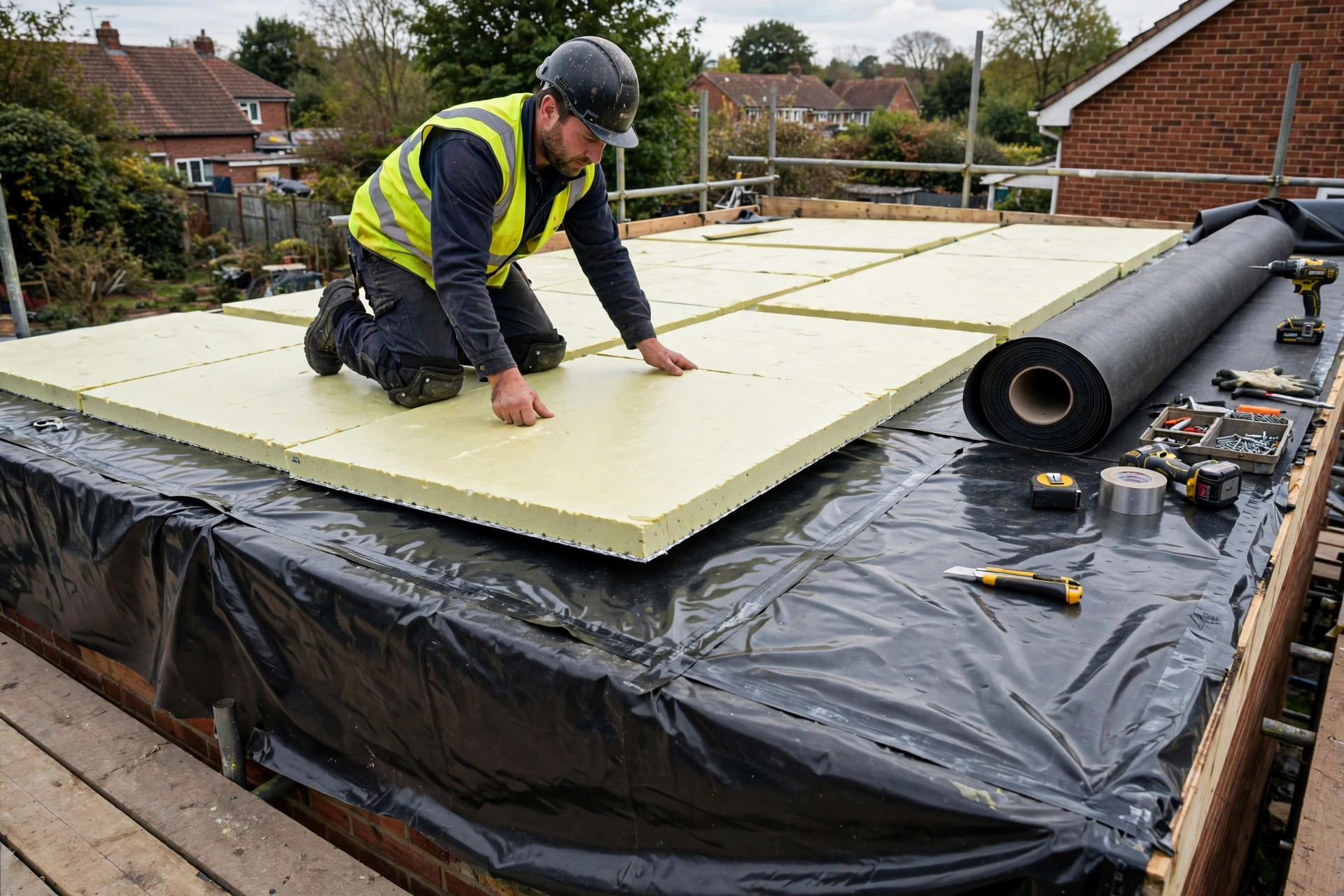
When roofers talk about “warm roof vs cold roof,” they’re not talking about the waterproofing on top — the felt, GRP, or EPDM. They mean what’s underneath: where the insulation sits in the build-up. And it matters more than most homeowners realise, because it decides whether your roof suffers condensation, noise, and heat loss.
Here’s how each build-up works, the pros and cons, and which one we’d recommend for your flat roof.
The cold roof build-up (and why it’s falling out of favour)
In a cold roof, the insulation sits between the joists, below the roof deck — usually at ceiling level. The roof deck and the void above the insulation stay cold, hence the name.
To stop condensation, a cold roof needs cross-ventilation: air must flow through the void above the insulation, entering at one side and leaving at the other, carrying moist air away before it condenses on the cold underside of the deck.
The problem? In practice, that ventilation is very often inadequate — blocked by insulation that’s been pushed too tight, missing vents, or joists running the wrong way. The result is the classic cold-roof failure: condensation forming on the underside of the deck, rotting the timbers from the inside out. You can’t see it happening until the damage is done.
Cold roofs are also noisier with rigid systems — that infamous GRP popping and creaking in temperature swings is worst on cold decks, because the membrane sits on a deck that swings wildly in temperature. (More on that in our fibreglass roof problems guide.)
The warm roof build-up (the modern standard)
In a warm roof, the insulation sits above the deck, directly under the waterproof membrane. The structure — deck, joists, everything — stays on the warm side of the insulation, close to indoor temperature.
Because the deck stays warm, condensation risk virtually disappears. No ventilation void needed, no hidden rot, no cold bridging through the joists. It’s thermally more efficient too, since the insulation forms one continuous blanket with no gaps around joists.
A vapour control layer goes on the warm side of the insulation (directly over the deck) to stop indoor moisture migrating up into the build-up. Then insulation boards, then your membrane — EPDM, GRP, or felt — on top.
Warm roof vs cold roof: head to head
| Warm roof | Cold roof | |
|---|---|---|
| Condensation risk | Very low | High if ventilation fails |
| Thermal efficiency | Better (continuous insulation) | Worse (bridging through joists) |
| Noise (with GRP) | Quieter, stable temperatures | Popping/creaking common |
| Build-up height | Adds 100–150mm above deck | No added height |
| Ventilation needed | No | Yes — and it must work |
| Cost | Higher (more materials) | Lower |
What about the “inverted” roof?
You’ll sometimes hear about inverted (or “upside-down”) roofs, where the insulation sits above the waterproof membrane, held down with ballast or paving. These are mainly a commercial thing — great for roofs that get heavy foot traffic or will carry plant equipment, because the membrane is protected. For a domestic extension or garage, a standard warm roof is almost always the better value.
Which should you choose?
For a new flat roof or full replacement: warm roof, almost every time. It’s the current best practice, it kills the condensation problem at the root, and it performs better thermally — which matters with energy prices where they are. Building regulations effectively push this way too: if you’re replacing more than a quarter of a roof, the thermal upgrade requirements usually make a warm-deck build-up the compliant choice.
When might cold roof still make sense? The main constraint is height. A warm roof adds 100–150mm above the existing deck, which can cause problems at door thresholds, parapet heights, or where the roof abuts an upstairs window. If you physically can’t gain the height, a cold roof done properly — with genuinely effective cross-ventilation — is the fallback. But “done properly” is doing a lot of work in that sentence; most of the rotten decks we replace came from cold roofs where the ventilation existed on paper only.
For an overlay (new membrane over the old roof): a warm-deck overlay — tapered or flat insulation boards over the existing roof, then a new membrane — is often the smartest fix for an old cold roof. You fix the condensation risk and can even correct ponding with tapered boards at the same time.
What does each cost in London?
2026 ballpark bands for a 20–30m² domestic flat roof, fully installed:
- Cold roof replacement (membrane + deck as needed): £2,000–£4,000 depending on system
- Warm roof replacement (deck + VCL + insulation + membrane): £3,200–£6,000 depending on system and insulation thickness
- Warm-deck overlay over existing roof: £90–£140 per m²
The warm roof costs more upfront — typically £1,000–£2,000 more on a garage-sized roof. Against that: no condensation rot risk, lower heating bills, a quieter roof, and a build-up that meets current regulations. Most of our domestic re-roofs in London are warm-deck now, and we rarely recommend otherwise.
A note on condensation vs leaks
If you’ve got damp patches on the ceiling below a flat roof, don’t assume the membrane has failed — cold-roof condensation is one of the most misdiagnosed “leaks” we see. A proper survey distinguishes the two, because the fixes are completely different. Our loft condensation vs roof leak guide explains how to tell them apart.
Get the right build-up for your roof
Victoria Roofing Expert Ltd — 188 Camden High St, London NW1 8QP, 07848 256099. Family-run since 1982, 5.0 from 338 Google reviews, open 24 hours. We’ll survey your flat roof, explain which build-up suits it (and why), and our workmanship is fully guaranteed.
See our flat roof repair in London page, or get a free quote — honest advice, fair fixed price, no obligation.