
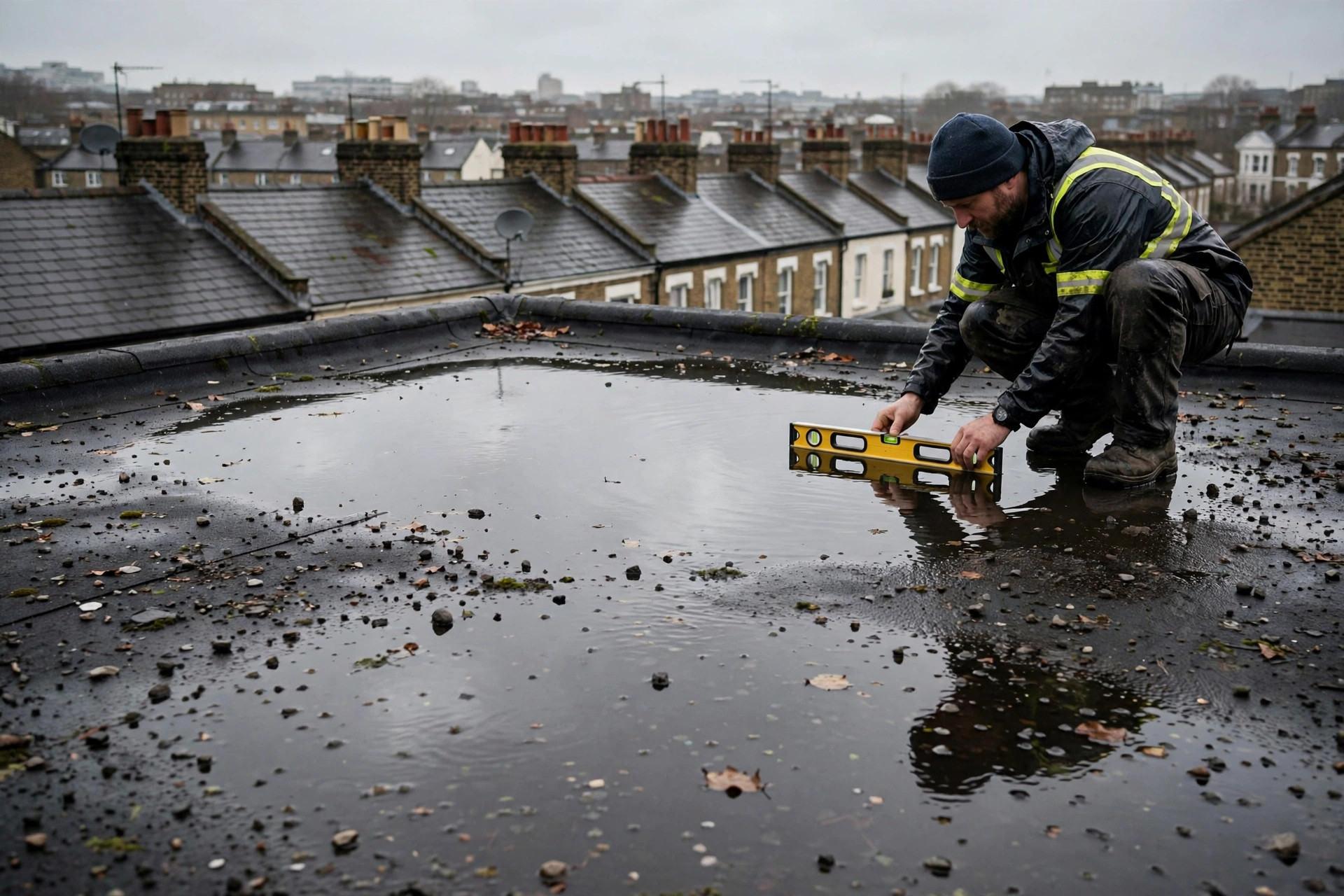
After heavy rain, most flat roofs hold a few shallow puddles for a while. That’s normal. What isn’t normal is water still sitting there two days later — that’s ponding, and it’s one of the most common reasons flat roofs fail early.
Here’s what causes ponding water on flat roofs, when to worry, and how to fix it properly.
What counts as ponding?
Roofing guidelines generally say water that remains 48 hours after rain has stopped is ponding. A puddle that dries up within a day is just slow drainage — not ideal, but not an emergency.
Why does 48 hours matter? Standing water adds weight (a square metre of water 25mm deep weighs 25kg), accelerates the breakdown of felt and bitumen systems, encourages algae and moss growth, and in winter can freeze, expand, and stress the membrane. It also means any tiny defect in the waterproofing sits permanently submerged — exactly where leaks start.
What causes ponding on a flat roof?
Insufficient fall. A flat roof should never be truly flat — it needs a fall of at least 1:80 (roughly 1cm per 80cm) towards the outlets. Many older roofs were built nearly level, or the fall was lost as the structure settled over the years.
Blocked or badly placed outlets. Leaves, moss, and debris choke gutters and downpipes. Sometimes the outlets are simply in the wrong place — water has to travel too far across the roof to reach them.
Sagging deck. Timber decks sag between joists over time, especially if the boards have got damp. Each sag becomes a little bowl that holds water. Once ponding starts, the extra weight makes the sag worse — a slow vicious circle.
Compressed insulation. On warm-deck roofs, insulation boards can compress under the weight of standing water or foot traffic, creating dips.
Poor detailing around features. Skylights, vents, and upstands interrupt the flow of water. If the falls weren’t planned around them, water collects in their shadow.
When is ponding actually a problem?
Ask yourself three questions:
- Does it drain within 48 hours? If yes, monitor it. If no, it needs attention.
- Is the area growing? Mark the edge of the puddle with chalk after rain. If it’s bigger next month, the deck is sagging and the problem is getting worse.
- Is there a leak? Water coming through the ceiling below a ponded area means the membrane has already failed there — don’t wait.
One thing worth knowing: ponding voids some manufacturer warranties. If your roof is under guarantee, check the terms — many require proper drainage as a condition.
Fixes for ponding water, from simplest to most involved
Clear the drainage. Start here — it’s free. Clear gutters, downpipes, and roof outlets of leaves and moss. We see roofs “fixed” by a ten-minute clear-out more often than you’d think. Our guide to how to clean gutters safely covers the basics.
Add or reposition outlets. If water can’t reach the drain, an extra outlet or a repositioned downpipe can transform drainage. Cost in London: roughly £300–£700 per new outlet, depending on access.
Tapered insulation overlay. For roofs with poor falls, tapered insulation boards can be laid over the existing roof to create proper falls towards the outlets, then covered with a new membrane. This avoids stripping the whole roof and adds insulation at the same time. Typical cost: £90–£140 per m² in London, depending on the system.
Re-deck and re-fall. If the deck itself is sagging or rotten, the honest fix is to strip back, replace the decking, and rebuild with correct falls. More disruptive, but it’s the only fix that addresses the root cause. This usually forms part of a full re-roof — see our flat roof repair in London page for what’s involved.
Structural check. If ponding appeared suddenly on an older roof, get the structure checked. A joist problem is rare, but it’s the one cause you don’t want to guess about.
Can you just live with it?
If the puddles drain within a day or two, the membrane is in good condition, and the area isn’t growing — yes, with monitoring. Keep the outlets clear and check it each autumn.
But “a bit of ponding” is how a lot of premature flat roof failures start. Standing water finds every weakness: a slightly lifted seam, a pinhole in the felt, a perished flashing. On felt roofs especially, permanent submersion shortens life noticeably. If your roof is felt and ponding, it’s worth reading how long a felt roof lasts to judge where yours is in its lifespan.
What we do on a ponding survey
When we survey a ponding roof, we check the falls with a level, inspect every outlet, walk the deck feeling for soft spots and sags, and look at the membrane condition in the ponded areas. Then we give you the options honestly — sometimes that’s a £300 outlet fix, sometimes it’s a re-deck. We won’t sell you a new roof when a clear-out and an extra downpipe will do.
Get your flat roof draining properly
Victoria Roofing Expert Ltd — 188 Camden High St, London NW1 8QP, 07848 256099. Family-run since 1982, 5.0 from 338 Google reviews, open 24 hours. We survey flat roofs across Camden and all of London, and our workmanship is fully guaranteed.
See our guttering services if drainage is the issue, or get a free quote for an honest assessment of your ponding problem.