EPDM rubber roofing has become one of the most popular choices for UK flat roofs — garages, extensions, dormers, and porches. It’s a single flexible rubber membrane, most famously made by Firestone, and it’s earned its reputation. But it’s not perfect for every roof.
Here’s the honest rundown of EPDM roofing pros and cons, what it costs in London in 2026, and when we’d recommend something else instead.
What is EPDM roofing?
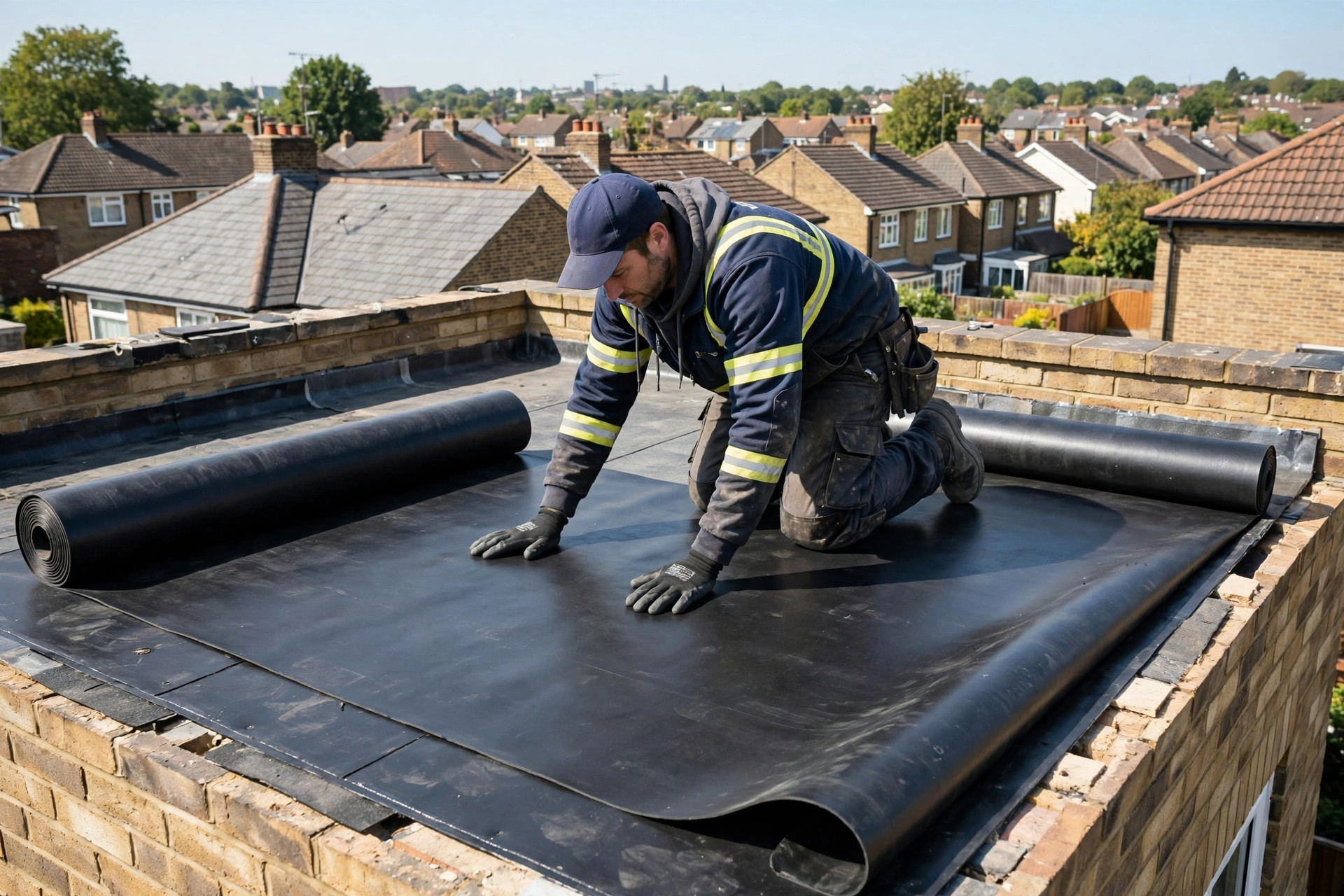
EPDM (ethylene propylene diene monomer) is a synthetic rubber sheet, typically 1.2mm or 1.5mm thick, supplied in large rolls — sometimes big enough to cover a whole domestic roof in one piece. It’s glued to the roof deck (fully adhered), mechanically fixed, or ballasted, with joints sealed using primer and seam tape.
No hot works, no resin fumes, no curing time. That simplicity is a big part of its appeal.
The pros of EPDM roofing
Exceptional lifespan. This is EPDM’s headline strength. A properly installed EPDM roof realistically lasts 30–50 years. The rubber doesn’t rot, doesn’t crack with age, and shrugs off UV. We’ve seen 25-year-old EPDM roofs that still look and perform like new.
Few seams, fewer leaks. Leaks on flat roofs usually start at joints. Because EPDM comes in huge sheets, a typical garage or extension roof can be done with zero field seams — one continuous waterproof skin. Fewer seams means fewer failure points.
Quick, clean installation. Most domestic EPDM roofs are finished in a day. There’s no smell to speak of, no noisy equipment, and no weather-curing delays the way GRP resin has. If you need a leak sorted fast, that speed matters.
Flexible in cold weather. Unlike rigid systems, EPDM stays flexible in frost and handles building movement without cracking. For older London properties that shift slightly with the seasons, that’s a real advantage.
Low maintenance. Once it’s down, there’s very little to do — keep outlets clear, have a look at it once a year. It doesn’t need recoating or repainting the way some systems do.
Good value. EPDM sits in the middle of the price range — cheaper than GRP or a full lead roof, more than basic felt. For lifespan-per-pound, it’s hard to beat. Typical 2026 London prices: £90–£130 per m² installed, or roughly £1,800–£3,200 for a standard garage-sized roof.
The cons of EPDM roofing
Vulnerable to punctures. The honest weakness. EPDM is tough, but it’s still rubber — sharp tools, dropped screws, and yes, cat claws can puncture it. If the roof gets regular foot traffic or you store things up there, it needs protection boards or walkway pads.
Shrinkage if badly installed. Cheap or rushed EPDM work can shrink back from edges over time, pulling at flashings and upstands. This is an installer problem, not a material problem — but it’s the most common EPDM failure we get called to fix. Proper perimeter detailing prevents it entirely.
Black and… black. Standard EPDM is black. It looks neat, but on a highly visible roof some homeowners find it stark, and it absorbs heat in summer. (Lighter-coloured membranes exist but cost more and are harder to source in the UK.)
Seam quality varies. Factory seams are excellent; site-made seams depend entirely on the installer. Tape-and-primer joints done in damp or dusty conditions are the weak link. Ask any roofer quoting EPDM how they detail their seams — a good one will explain it gladly.
Not ideal for complex shapes. EPDM is a sheet, so roofs with lots of angles, curves, and fiddly detailing take more skill (and more seams). For very complex shapes, a liquid-applied system or GRP can be the better call.
EPDM vs the alternatives
EPDM vs GRP (fibreglass): EPDM is usually cheaper and faster; GRP handles foot traffic and complex detailing better. We’ve compared them in depth in our GRP vs EPDM guide.
EPDM vs felt: EPDM costs more upfront but lasts roughly twice as long as a typical torch-on felt roof, with far less maintenance. If you’re planning to stay in the property, EPDM usually works out cheaper over its lifetime. Felt’s lifespan is covered in our how long does a felt roof last guide.
EPDM vs liquid systems: Liquid-applied membranes are excellent for complex detailing and repairs, but for a straightforward re-roof, EPDM’s single-sheet simplicity is hard to argue with.
What does EPDM roofing cost in London?
Realistic 2026 bands for a professional installation:
- Small porch/dormer (10–15m²): £1,200–£2,000
- Single garage or extension (20–30m²): £1,800–£3,200
- Large extension (40–60m²): £3,500–£6,000
These assume a sound deck. If the decking needs replacing, add roughly £40–£70 per m². Quotes far below these bands usually mean corners cut on membrane thickness, seam detailing, or edge trims — the exact things that determine whether it lasts 40 years or 4.
Is EPDM right for your roof?
EPDM is our default recommendation for straightforward domestic flat roofs in London: garages, extensions, and dormers with simple rectangular shapes. It’s the best balance of cost, lifespan, and reliability we fit.
We’d steer you elsewhere if the roof gets heavy foot traffic (consider GRP), has very complex detailing (consider liquid systems), or the deck underneath is in poor shape (fix the deck first, whatever goes on top).
Get an honest EPDM quote
Victoria Roofing Expert Ltd has fitted EPDM across Camden and all of London since 1982. Family-run, 5.0 from 338 Google reviews, open 24 hours, and our workmanship is fully guaranteed.
See our flat roof repair in London page if your existing roof needs attention, or get a free quote — we’ll survey the roof, tell you straight whether EPDM suits it, and give you a fair fixed price.