
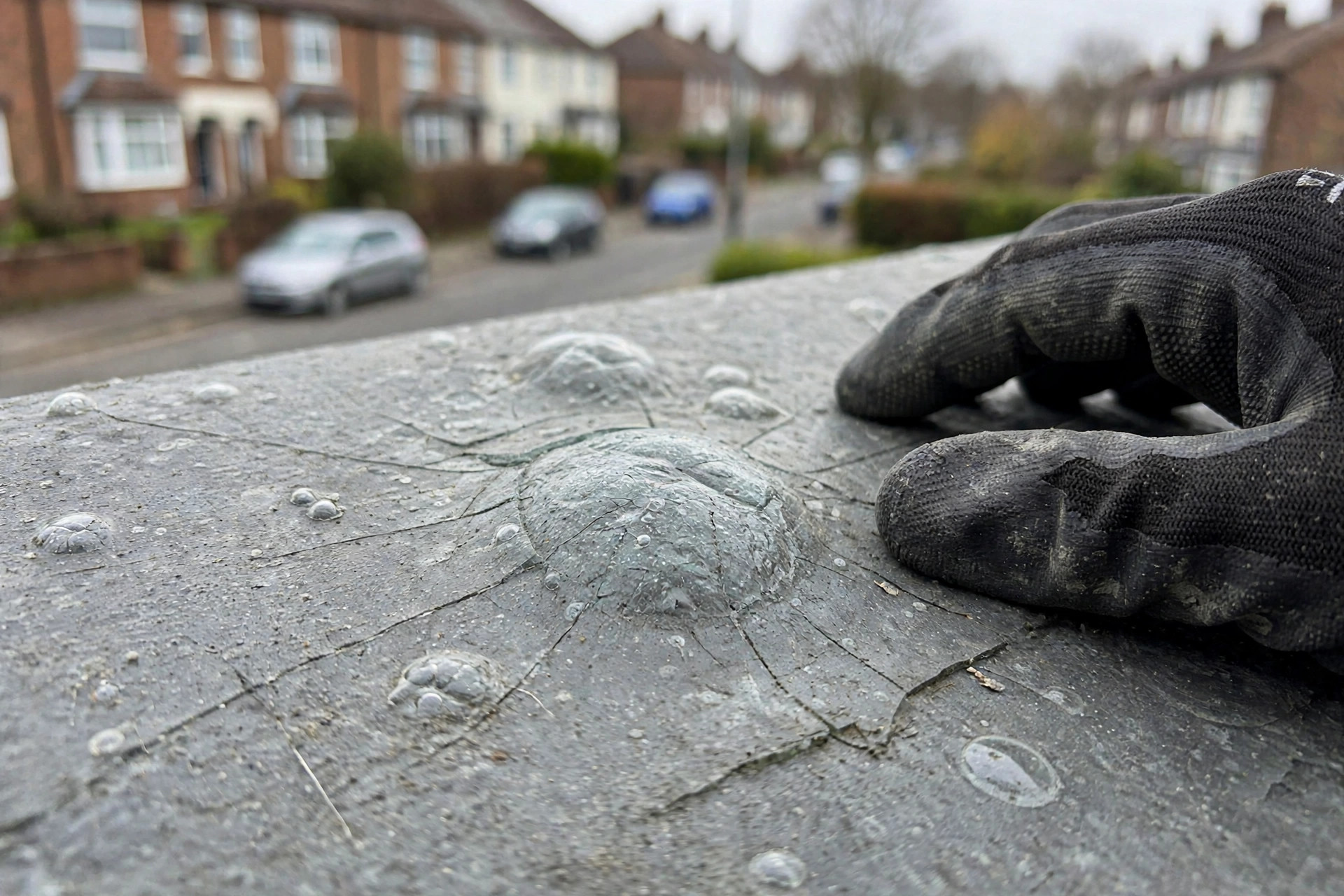
A well-laid GRP (fibreglass) flat roof is a superb thing — seamless, tough, and good for 20–30 years. But we’ve all seen the other kind: the one that started bubbling the summer after it was laid, cracks every winter, or pops and creaks like it’s haunted.
These are the most common fibreglass flat roof problems we get called to in London, what causes each one, and — honestly — which can be fixed and which mean replacement.
Bubbling and blistering
What it looks like: Raised bubbles or blisters in the GRP surface, sometimes small and scattered, sometimes big enough to stand on.
What causes it: Almost always moisture trapped under or within the laminate during installation. If the deck was damp when the resin went down, or resin was applied in humid conditions, moisture gets sealed in. Summer heat turns it to vapour, and up comes a bubble. Poor resin mixing (wrong catalyst ratio) causes similar problems — the laminate never fully cures.
Can it be fixed? Small, isolated blisters can sometimes be cut out, dried, and patched with new laminate. Widespread bubbling across the whole roof usually means the installation was fundamentally flawed — patching buys time, but the honest advice is often replacement. This is the classic “cheap quote” failure: rushed GRP laid on a damp deck in October.
Cracking
What it looks like: Hairline cracks in the topcoat, or deeper cracks through the laminate itself, often around edges, upstands, or where the roof meets walls.
What causes it: GRP is rigid, and rigid things crack when the structure beneath them moves. The usual culprits are thermal movement (the shell expanding and contracting against a deck that moves differently), an inadequate deck (thin boards that flex between joists), or impact damage. Topcoat-only cracks are often cosmetic; cracks through the laminate let water in.
Can it be fixed? Hairline topcoat cracks can be sanded back and recoated — a straightforward repair costing roughly £300–£600 for a localised area in London. Structural cracking through the laminate needs the affected section cut out and re-laminated. If cracking is widespread, the deck or the original specification is the problem, and repairs become whack-a-mole.
Noise: popping, cracking and creaking
What it sounds like: Loud pops or cracks, often in the morning as the sun hits the roof or in the evening as it cools. Some homeowners describe it as sounding like someone walking on the roof.
What causes it: Thermal shock — the GRP shell expanding and contracting at a different rate to the deck beneath. It’s most common on cold-deck roofs where the GRP sits directly over a ventilated void, and where the laminate wasn’t properly bonded to the deck. It’s worse on dark topcoats and south-facing roofs.
Can it be fixed? Honestly, this is the hardest GRP problem to solve without replacement. The noise comes from movement between layers, and you can’t re-bond a cured laminate from above. Some relief comes from a warm-deck overlay (insulation over the existing roof, then a new membrane), which evens out temperature swings — but that’s a significant job. If you’re at the quoting stage, this is worth knowing: a proper warm-deck build-up largely prevents the problem. See our warm roof vs cold roof guide for the full explanation.
Leaks at edges and upstands
What it looks like: Damp patches on ceilings near the roof perimeter, or water tracking down internal walls below the roof edge.
What causes it: Detailing failures — the GRP wasn’t dressed properly up the wall, into the gutter, or around skylights and vents. Edge trims pulling away, perished sealant at abutments, or GRP that was simply stopped short and “finished” with mastic. Mastic is not a long-term waterproofing detail, whatever anyone tells you.
Can it be fixed? Usually yes — this is the most repairable category. Re-detailing an edge or upstand with new laminate and proper trims typically costs £400–£900 in London depending on length and access. We do a lot of these.
Ponding and premature wear
GRP tolerates occasional standing water, but permanent ponding accelerates topcoat breakdown and finds every tiny defect. If your GRP roof holds water for days after rain, the drainage needs sorting regardless of the membrane’s condition.
Delamination
What it looks like: Areas where the GRP shell has lifted away from the deck — it sounds hollow when tapped and may flex underfoot.
What causes it: Poor bond during installation (dusty or damp deck, resin going off before the mat was laid into it) or long-term moisture ingress underneath. Once delaminated, that section of roof is just a loose shell — it can’t do its job.
Can it be fixed? Small delaminated areas can be cut out and re-laminated. Large areas mean replacement of that section at minimum.
Repair or replace? An honest framework
- Localised problem, rest of roof sound → repair it. Edge details, isolated blisters, and topcoat cracks are all fixable.
- Widespread bubbling or cracking under 10 years old → the installation failed; chase the original installer’s guarantee first, then get independent quotes for replacement.
- Roof over 20 years old with multiple issues → replacement usually makes more sense than a patchwork of repairs. Compare your options in our GRP vs EPDM guide.
- Noise problems → manage expectations; a full fix usually means a new build-up.
One caution from the question we hear most: “the company that laid it has gone bust — what is my guarantee worth?” A guarantee is only as good as the company behind it. This is why we tell people to choose established, local roofers with a track record — it’s not sales patter, it’s the difference between a guarantee you can use and a piece of paper.
GRP problems in London? Get an honest diagnosis
Victoria Roofing Expert Ltd — 188 Camden High St, London NW1 8QP, 07848 256099. Family-run since 1982, 5.0 from 338 Google reviews, open 24 hours. We’ll survey your GRP roof, tell you straight whether it wants a repair or a replacement, and our workmanship is fully guaranteed.
See our flat roof repair in London page, or get a free quote — no obligation.