
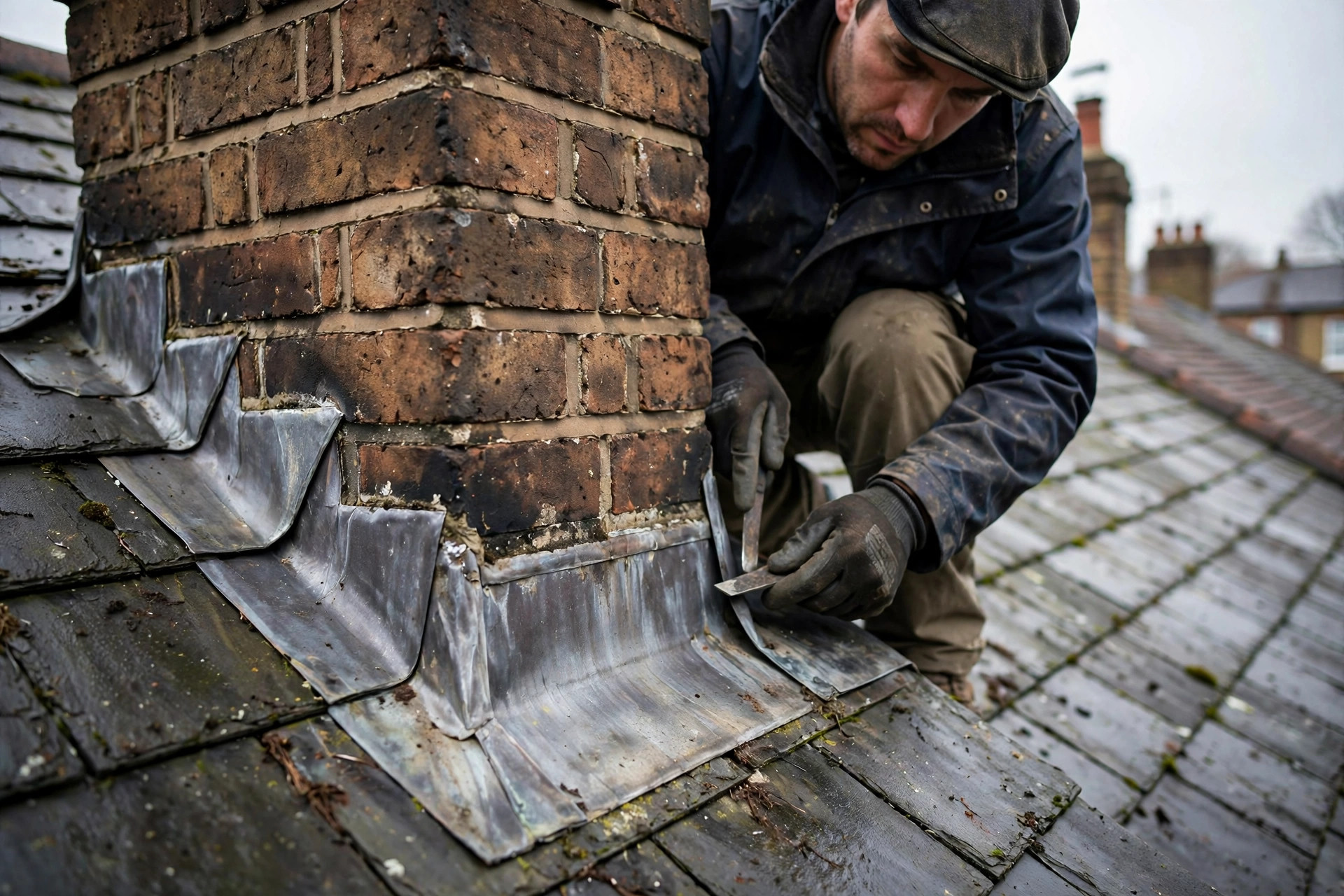
If there’s a damp patch on an upstairs ceiling or a brown stain creeping down a bedroom wall, the chimney is the first place an experienced roofer looks. The flashing — the weatherproof seal where the chimney stack meets the roof — is one of the hardest-working and most failure-prone details on any pitched roof. Here’s how to tell whether the flashing is your culprit, what a proper diagnosis looks like, and how it’s fixed.
What is chimney flashing?
Flashing is the waterproof joint between the chimney stack and the roof covering. On a proper job it’s made of lead: individual lead soakers tucked under each course of tiles or slates where the roof meets the chimney sides, a lead apron at the front, and step flashing cut into the brickwork at the back and sides. The lead is “chased” into a horizontal mortar joint in the brickwork, typically 25mm deep, and sealed.
It has to cope with a lot. The chimney and the roof expand and contract at different rates, the flashing sits in the path of all the water running down the slope above, and wind drives rain straight at it. When it fails, water runs down the outside of the stack or along the underlayment and shows up inside — often some distance from the chimney itself, which is why these leaks can be tricky to pin down.
Signs the leak is the flashing
A chimney flashing leak tends to announce itself in fairly specific ways:
- Damp or staining on the ceiling or wall near the chimney breast, especially after wind-driven rain
- Water marks that appear on the slope side of the chimney, worst in heavy weather
- Damp in the loft around the base of the stack, with the rest of the loft dry
- Water dripping down the inside of the chimney breast in the loft
- A leak that comes and goes with the direction of the wind — classic flashing behaviour
If the damp is on the chimney breast itself and present even in dry spells, the problem may be condensation or porous brickwork rather than flashing. Our guide to chimney repair in London covers the full range of chimney issues.
How a chimney flashing leak is diagnosed
Guessing is expensive — homeowners sometimes pay for a full repoint or even a rebuild when the flashing was the actual problem. A proper diagnosis usually involves:
- Loft inspection. The roofer looks at the underside of the roof around the stack in daylight (or with a torch in the rain) to trace where water is entering. Wet battens or underlayment on one side of the stack points at that side’s flashing.
- External inspection. From a ladder or scaffold: is the lead cracked, split, lifted, or missing? Has the chase seal failed? Is the step flashing properly cut into the brickwork, or just face-fixed with sealant (a common bodge)?
- Hose test. With someone in the loft watching, water is run gently over the flashing area section by section. When the leak appears inside, the source is confirmed. This is the most reliable way to isolate a flashing leak from repointing or brickwork issues.
It’s worth knowing that flashing is only one suspect. Failed mortar between the bricks, porous render, and a damaged flaunching (the mortar cap on top of the stack) can all let water in at the same spot. A good roofer checks all of them before quoting. If the mortar is the issue, see our article on chimney repointing costs in London.
What a proper repair looks like
A lasting repair means renewing the lead properly, not smearing more sealant over the old stuff. The correct method:
- Strip out the failed flashing and any perished sealant
- Cut a new chase into the brickwork mortar joint (around 25mm deep)
- Fit new lead soakers under the tile or slate courses on both sides
- Fit step flashing up the sides, dressed into the chase and sealed with a proper lead sealant or mortar
- Fit a new lead apron at the front of the stack
- Dress the lead to follow the profile of the roof covering so water can’t track underneath
Lead is used because it lasts — a correctly installed lead flashing should give 30–50 years of service. Beware of “repairs” that just involve painting bitumen mastic or silicone over the old flashing. These are temporary patches at best; they crack within a couple of winters and the leak comes back.
Chimney flashing repair costs in London
As a guide to typical 2026 London pricing:
- Minor flashing repair (re-seal a chase, re-dress lifted lead): £250–£500
- Full lead flashing renewal on one chimney: £750–£1,500
- Flashing renewal plus repointing the stack: £1,500–£2,500
- Scaffolding: £400–£900 extra if the chimney can’t be reached safely from a roof ladder
The price moves with the size of the stack, how many sides need new lead, the roof covering (slate takes longer than plain tiles), and access. If the stack itself is in poor condition, it may be worth comparing repair against removal — our article on chimney stack removal vs repair walks through the decision.
Temporary fixes that buy you time
If the leak appears during a storm and you can’t get a roofer up there immediately, a self-adhesive flashing tape (like Flashband) pressed firmly over a cracked joint can keep water out for a few months. Lead mastic painted over the failed area works similarly. These are stopgaps, not solutions — they don’t bond like new lead and they deteriorate fast in UV. Use them to protect the interior, then book the proper repair.
When the problem isn’t the flashing
Two situations regularly get misdiagnosed as flashing leaks. The first is chimney saturation: on very exposed stacks, wind-driven rain soaks straight through porous brickwork or failed render, and damp appears inside even with perfect flashing — repointing or rendering is the fix. The second is condensation in a disused flue, where warm moist air from the house condenses on the cold brickwork and runs down. If your diagnosis points away from flashing, the roofer should be able to tell you which of these it is and what to do about it.
Get a proper diagnosis
A chimney leak is exactly the kind of problem where the right diagnosis saves you hundreds of pounds. Victoria Roofing Expert Ltd is a family-run roofing contractor at 188 Camden High St, London NW1 8QP, serving Camden and all of London since 1982. We’ll trace your leak properly — loft inspection, external check, and hose test where needed — and quote the actual fix, not the most expensive one. Fully guaranteed workmanship, 5.0 from 338 Google reviews.
Call 07848 256099 — open 24 hours — or request a free quote via our contact page.