
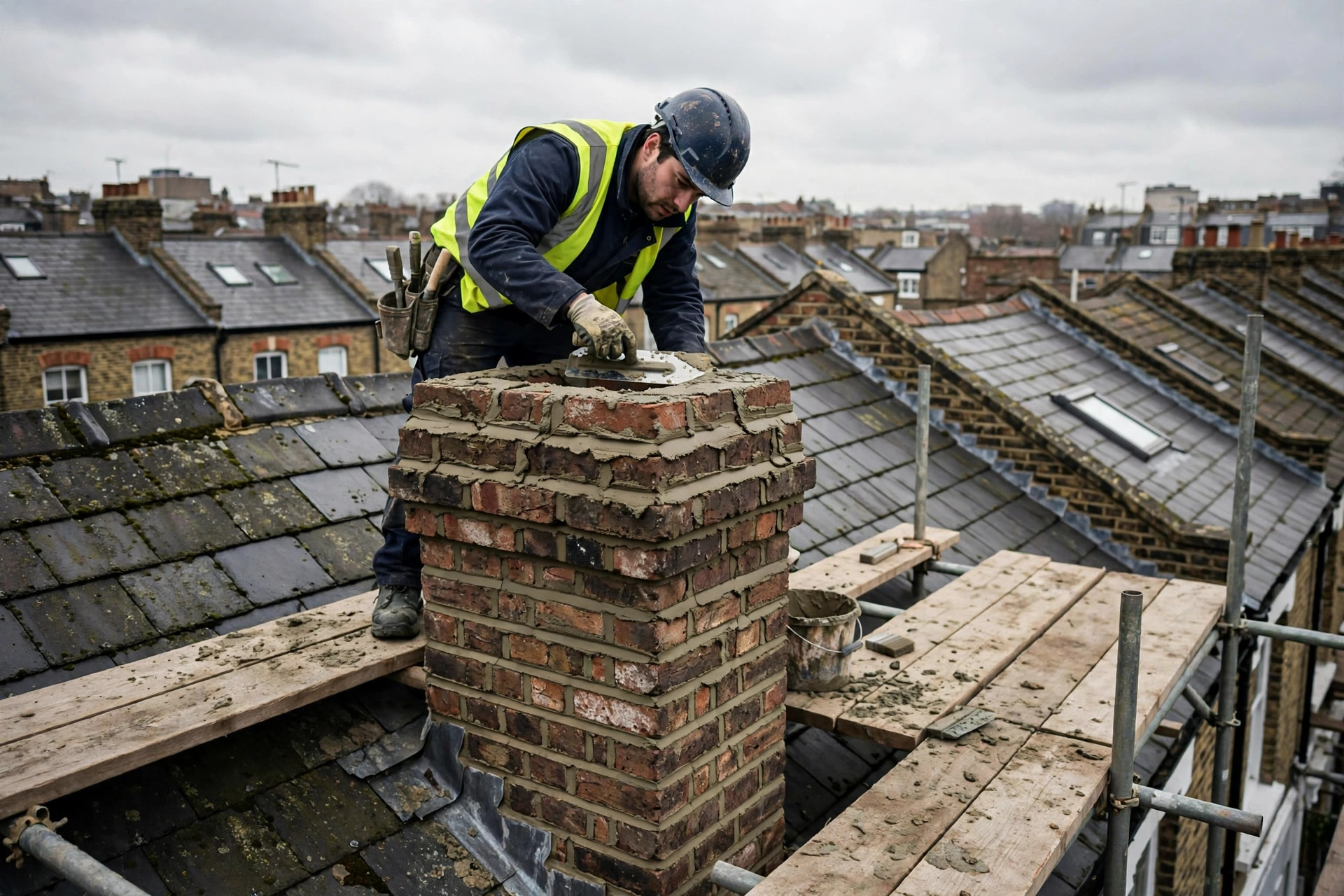
Crumbling mortar on a chimney stack is one of the most common problems on London’s older housing stock. Water gets in, bricks work loose, and eventually the stack becomes a safety risk. Repointing — raking out the failed mortar and replacing it — is the standard fix. Here’s what it realistically costs in London in 2026.
How much does chimney repointing cost in London?
For a standard London chimney stack, realistic 2026 prices are:
- Repointing a single chimney stack (full stack, all faces): £900–£2,000
- Repointing two stacks on the same scaffold: £1,500–£3,000
- Small repoint of one face or a few courses: £400–£700
The wide range reflects access. A chimney that’s reachable from a roof ladder or a single scaffold lift costs far less than one on a three-storey terrace needing a full scaffold. In London, expect to pay toward the upper end — scaffolding alone often accounts for a third of the bill.
What does repointing actually involve?
Proper repointing means:
- Raking out the perished mortar to a proper depth (not just skimming over the top)
- Replacing it with a suitable mortar — usually a lime-based mix on older London brickwork, which flexes with the building
- Checking the bricks, flaunching (the mortar cap at the top) and pots while access is up
- Cleaning down so the stack looks right
If a quote just says “repointing” without mentioning raking out, ask — a skim of new mortar over failed old mortar will fail within a couple of years.
What affects the price?
Scaffolding or access. This is the big one. A chimney on a single-storey extension can sometimes be done from a tower; a stack on a Victorian terrace usually needs a proper scaffold, which is a significant part of the total cost.
Number of stacks. If both stacks on the property need doing, getting them done together is much cheaper per stack because the scaffold is already up.
Condition of the brickwork. If bricks are spalling (faces blowing off) or the stack is leaning, repointing alone won’t fix it — you may be looking at partial or full rebuild, which is a different job and price.
Flaunching and pots. While the scaffold’s up, it often makes sense to renew cracked flaunching (£150–£350) and replace damaged pots (£80–£150 each fitted). Doing these separately later means paying for access twice.
Flashings. Repointing is the moment to check the chimney flashing — if the lead is cracked or the soakers have failed, renewing it while you’re up there saves a fortune compared to a separate visit.
How to tell your chimney needs repointing
Stand back and look at the stack from the garden or across the street. The signs are easy to spot once you know them: mortar that’s crumbling or missing between courses, visible gaps where you can poke a finger in, white powdery staining (efflorescence) on the brickwork, and bricks whose faces are blowing off in flakes. Inside, look for damp patches on the chimney breast upstairs — especially after wind-driven rain — and loose mortar dropping into the fireplace or flue. If the pointing is just weathered on the surface but still firm when you scratch it with a screwdriver, it can usually wait a year or two. If it crumbles and falls away at a touch, book it in.
Repointing vs rebuilding: where’s the line?
Repointing fixes failed mortar. It doesn’t fix:
- A leaning stack — that’s structural and needs rebuilding
- Severely spalled bricks throughout — repointing around crumbling bricks is cosmetic
- Internal flue problems — different trade
As a rule of thumb, if more than a few courses need rebuilding or the stack moves when pushed, get advice on a rebuild rather than paying for repointing that won’t last. A chimney that’s leaking around the stack often needs flashing work alongside the pointing — the two jobs go hand in hand.
What mortar should be used?
On pre-1930s London stock, the bricks are softer than modern ones, and the original mortar was lime-based. Using hard cement mortar on old bricks traps moisture and accelerates spalling. A competent roofer or repointing specialist will match the mortar to the building — if a quote specifies “sand and cement” for a Victorian stack, that’s a red flag.
How long does repointing last?
A properly done lime repoint on a chimney should last 25–30 years or more. Cement repoints on suitable brickwork last similarly, but on old soft brick they can cause more damage than they prevent. The guarantee matters: we back all our work with fully guaranteed workmanship.
Can I just do it myself?
Chimney work is not a DIY job. It’s at height, the mortar mix matters, and a bad repoint causes more harm than leaving it alone. Even removing a chimney needs care — see our guide on chimney stack removal vs repair for when taking it down is the better option.
Getting a fair quote
Get the quote in writing with: which faces/courses are included, the mortar type, whether flaunching and pots are included, what access is provided, and the guarantee. If two quotes differ wildly, the access arrangements are usually the reason — not the labour rate.
Get a free, no-obligation quote
We repoint chimneys across Camden and all of London — often alongside flashing renewals, so one visit sorts the whole stack. Request a free quote and we’ll inspect the chimney properly, from a family-run team trading since 1982 with 338 five-star Google reviews.