
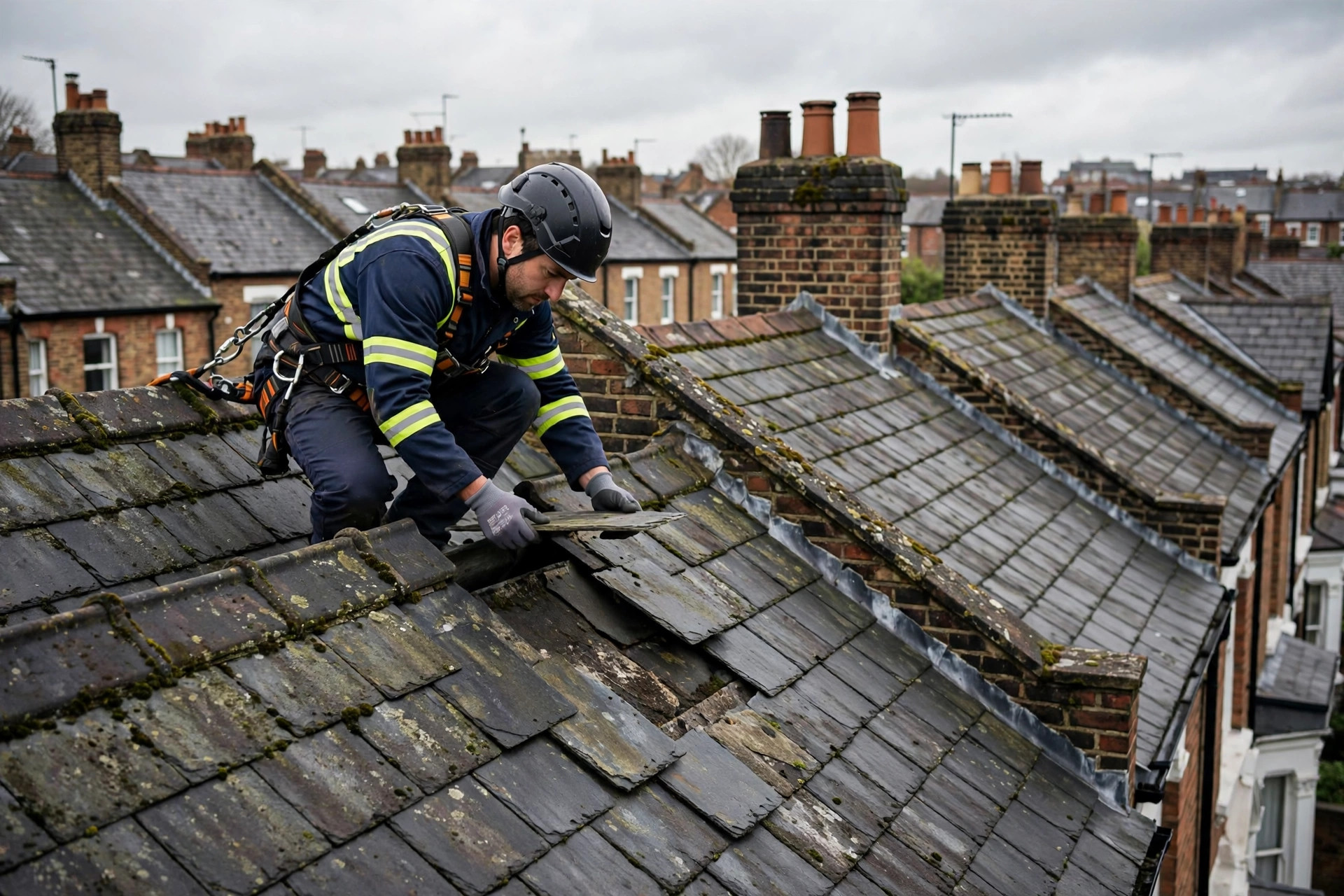
“How long does a roof last?” is one of the first questions homeowners ask us — usually when they’re buying a house, budgeting for the future, or staring at a quote for a replacement. The honest answer: it depends enormously on the material, and almost as much on the installation and maintenance.
Here are realistic UK lifespans for the main roof coverings, what affects them, and how to tell where your roof is in its life.
Slate roofs: 80–150 years
Natural slate is the marathon runner of roofing. A good Welsh slate roof, properly laid, can last a century or more — there are Victorian slate roofs across London still doing their job. Spanish and Brazilian slates are variable: decent ones manage 60–100 years, poorer ones far less.
But — and this is the part people miss — the slates usually outlast everything holding them up. Nails corrode (nail sickness is the classic slate roof killer), battens rot, and the old bitumen felt underlay perishes. A “failed” 90-year-old slate roof often has perfectly good slates; it’s the fixings and underlay that have given up. That’s why a slate re-roof often reuses the sound slates with new battens, membrane, and fixings.
Signs of an ageing slate roof: slipped or missing slates, slates that sound dull or crumble when tapped, visible nail corrosion in the loft, daylight through the roof.
Clay tiles: 60–100 years
Clay plain tiles and pantiles are nearly as long-lived as slate when they’re good quality. Like slate, they usually outlast their battens and underlay. Clay can suffer in freeze-thaw cycles if it’s porous — faces spall and flake — but quality clay tiles on a London roof typically see out their owners.
Concrete tiles: 40–60 years
Concrete tiles are the workhorse of post-war British housing, and they’re tougher than their reputation suggests. The tiles themselves rarely “fail” — what happens is the surface coating weathers off (they go from crisp grey to a mossy, weathered look), they get heavier as they absorb water, and moss takes hold.
The real lifespan limiter on concrete tile roofs is the underlay. Most 1960s–80s concrete tile roofs sit on bitumen felt underlay with a 20–30 year life. Once that felt perishes — and on a 50-year-old roof, it has — the tiles are the only thing between you and the weather. Tiles slip, valleys leak, and the roof becomes high-maintenance long before the tiles themselves are done.
Signs of an ageing concrete tile roof: heavy moss growth, granular surface loss (gutters full of sandy grit), slipped or cracked tiles, leaks at valleys and abutments.
Felt flat roofs: 10–25 years
Bitumen felt is the shortest-lived mainstream covering: 10–15 years for old pour-and-roll, 15–25 for modern torch-on systems. (We’ve covered felt in detail in our how long does a felt roof last guide.) If your property has both pitched and flat sections, the flat part will almost always need attention first.
What actually determines how long your roof lasts?
Installation quality matters more than the material’s theoretical lifespan. Correct headlap, proper battens, adequate ventilation, sound flashings — get these wrong and a “100-year” slate roof leaks in year five. This is why the cheapest quote is so often the most expensive roof.
Underlay and battens are the hidden clock. Whatever the covering, budget for the underlay’s lifespan as the realistic service interval: roughly 25–35 years for modern breathable membranes, 20–30 for old bitumen felt.
Maintenance buys decades. Cleared gutters, repointed ridges, replaced slipped tiles, sound flashings — small, cheap interventions that stop small problems becoming structural ones. A neglected 40-year-old roof can be in worse shape than a maintained 70-year-old one.
Exposure plays a part. A roof on an exposed hilltop weathers faster than the same roof in a sheltered London street. South-facing slopes age faster from UV; north-facing slopes grow more moss.
Moss deserves its own mention. It’s not just cosmetic — moss holds moisture against tiles, lifts their edges in frost, and blocks drainage paths. It’s also a symptom: heavy moss often means the tile surface has weathered enough to hold water.
How to tell how much life your roof has left
You don’t need to guess. A proper roof survey — from the ground with binoculars, on the roof itself, and in the loft — tells you the covering’s condition, the underlay’s state, and the structure beneath. We check all three, because a roof is a system, not just tiles.
As a rough guide:
- Under 20 years old, no issues: monitor, maintain, don’t worry.
- 20–40 years: start budgeting; get a survey every few years, especially for felt or ageing underlay.
- 40+ with original underlay: plan for a re-roof within the decade, even if the tiles look fine.
- Active leaks in multiple places, widespread tile failure, rotten battens: that’s a replacement conversation — see our roof repair vs replacement guide for how to decide.
Extending your roof’s life
The unglamorous truth: roofs die from neglect more than from age. Annual gutter clearing, prompt tile replacement, repointing ridges before they loosen, keeping flashings sound — none of it is expensive, and all of it pushes replacement years into the future. If you’re buying a house, a pre-purchase roof survey is the best £200–£400 you’ll spend; it tells you exactly what you’re inheriting.
How old is your roof, really?
Victoria Roofing Expert Ltd — 188 Camden High St, London NW1 8QP, 07848 256099. Family-run since 1982, 5.0 from 338 Google reviews, open 24 hours. We’ll survey your roof, tell you honestly how much life it has left, and our workmanship is fully guaranteed.
For a new roof, see our roof installation in London page; for problems with your current one, roof repair in London. Or get a free quote — no obligation.