
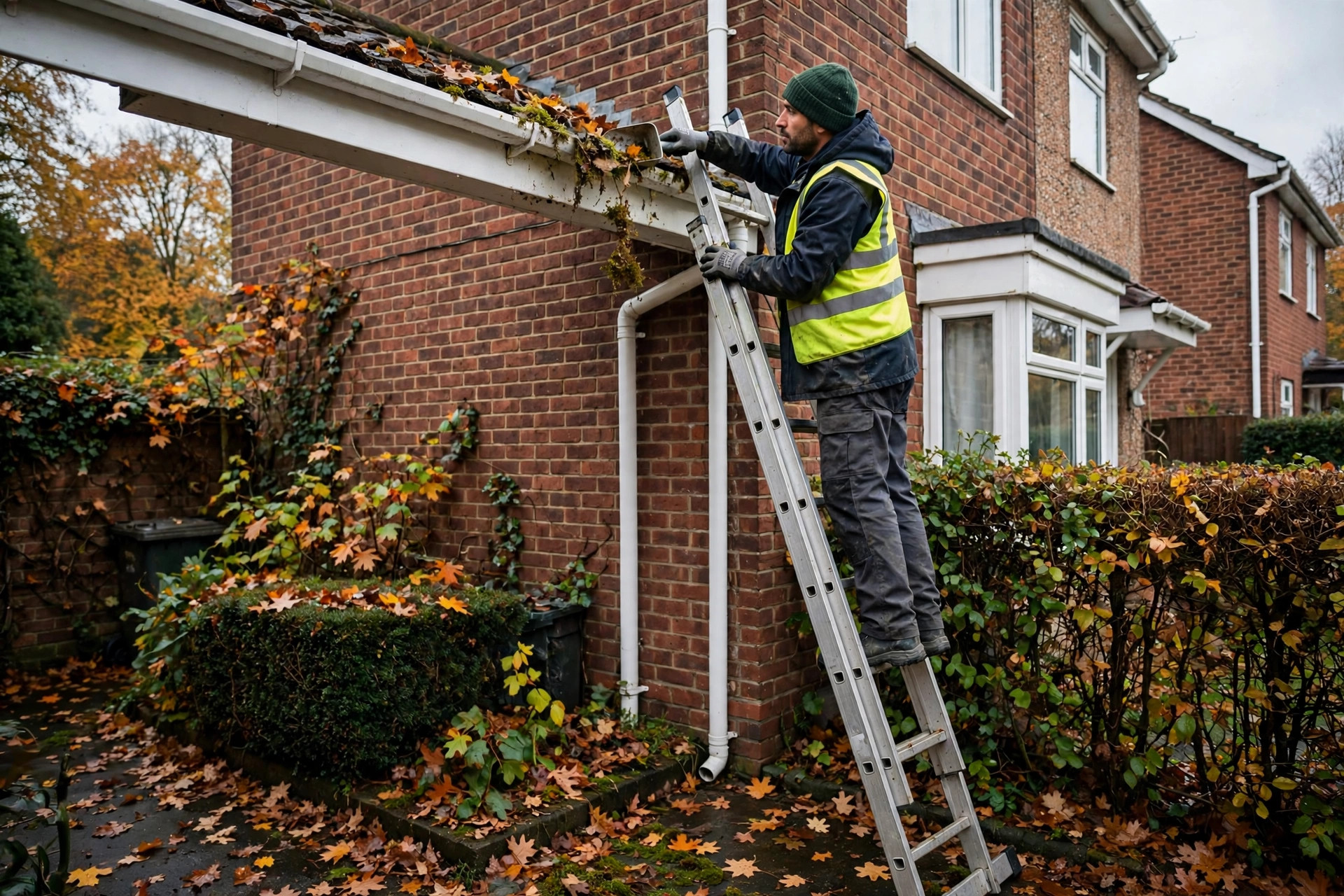
The short answer: twice a year — once in late autumn after the leaves have fallen, and once in spring. That is the standard advice for most UK homes, and in our experience it is about right.
But “most homes” is not “every home”. Some properties can get away with once a year; others genuinely need three or four cleans. Here is how to work out which camp you are in — and what happens if you leave gutters too long.
Why twice a year is the baseline
British weather is uniquely hard on gutters. Autumn brings the leaf fall, which is the obvious one, but spring matters just as much: winter storms wash moss, grit and broken tile fragments off the roof and into the gutters, and early spring is when seeds and blossom start to accumulate. A gutter that looks fine in March can be half-blocked by June.
The two-clean schedule also lines up with the moments problems are most likely to start. Blocked gutters in winter mean water overflowing during the heaviest rain of the year — exactly when you least want water running down your walls. A spring clean after winter gives you a clean system heading into summer growth season.
When you need more than twice a year
Certain homes need gutters cleaned three or even four times a year:
- Large trees near the house. If you have mature trees overhanging the roof — especially pines, which shed needles year-round — your gutters fill up far faster than average. This is the single biggest factor.
- Thatched or mossy roofs. Roofs that shed a lot of moss or debris keep gutters filling up between cleans.
- North-facing or shaded gutters. Gutters that rarely dry out grow algae and sludge faster, which compacts into a surprisingly solid blockage.
- Rental properties or blocks of flats. Where you cannot rely on anyone noticing a problem early, a more frequent schedule buys peace of mind.
If any of these apply, talk to your roofer about a quarterly schedule. It costs more, but it is still far cheaper than repairing damp damage.
Signs your gutters need cleaning now
Do not wait for the calendar if you spot any of these:
- Water overflowing or pouring over the sides during rain — the classic sign of a blockage
- Sagging gutters or sections pulling away from the fascia, which means they are heavy with trapped water and debris
- Plants or grass growing in the gutter — by this point it has been blocked for a while
- Damp patches or staining on the walls below the gutters, especially after heavy rain
- Water running behind the gutter and down the fascia boards rather than through the downpipe
- Birds or pests showing unusual interest in your gutters — they are often after nesting material or insects in the debris
If water is running behind the gutter rather than into it, the problem is usually the gutter’s alignment or the eaves detail rather than a simple blockage.
What happens if you never clean your gutters?
This is the part most homeowners underestimate. Blocked gutters do not just look untidy — they cause genuinely expensive damage:
Damp and penetrating water. When gutters overflow, water runs down the outside walls. Over time it soaks through brickwork and mortar, causing internal damp patches, peeling paint and damaged plaster. Damp repairs routinely run into the £500–£2,000 range — many times the cost of a gutter clean.
Rotting fascias and soffits. Water spilling behind gutters soaks into timber fascias and soffits, which rot from the inside out. Replacing fascias and soffits on a typical semi costs £1,500–£3,000 or more in London.
Foundation and drainage problems. Water pouring off the roof lands next to the foundations instead of being carried away by the downpipes. Over years, this can contribute to damp at ground level and even subsidence issues in extreme cases.
Pest problems. Stagnant water and debris in gutters attract mosquitoes, and birds nesting in blocked gutters can damage the guttering itself.
Invalidated insurance claims. Some home insurance policies expect reasonable maintenance. If a water-damage claim is traced back to gutters that have not been cleaned in years, the insurer may push back.
DIY or hire a professional?
Cleaning gutters yourself is possible — and our guide on how to clean gutters safely walks through it step by step. But be honest about the risks: ladder falls are one of the most common causes of serious DIY injuries in the UK. If your gutters are above a conservatory, on a three-storey house, or you are not steady on a ladder, hire someone.
A professional clean also includes things a DIY job usually misses — checking the gutter alignment, testing the downpipes are clear all the way down, and spotting early problems with the fascias, soffits or eaves felt while they are up there.
What does professional gutter cleaning cost in London?
For a typical London terraced or semi-detached house, a professional gutter clean generally costs £80–£150. Larger detached houses or properties needing tower scaffold access can run £150–£300. Most companies offer a discount if you book a regular schedule — which is exactly the kind of thing a maintenance plan can formalise. If your gutters are damaged rather than just dirty, our gutter replacement cost guide covers what to expect.
The simple rule
Twice a year as standard. More often if you have trees, a mossy roof, or shaded gutters. And act immediately on the warning signs — overflowing water, sagging, or plants growing where they should not be.
Gutter maintenance is one of the cheapest forms of home protection there is, and it is the one most often neglected. Our guttering services cover one-off cleans and regular schedules across Camden and all of London. Get a free quote — we are open 24 hours, family-run since 1982, and all our workmanship is fully guaranteed.