
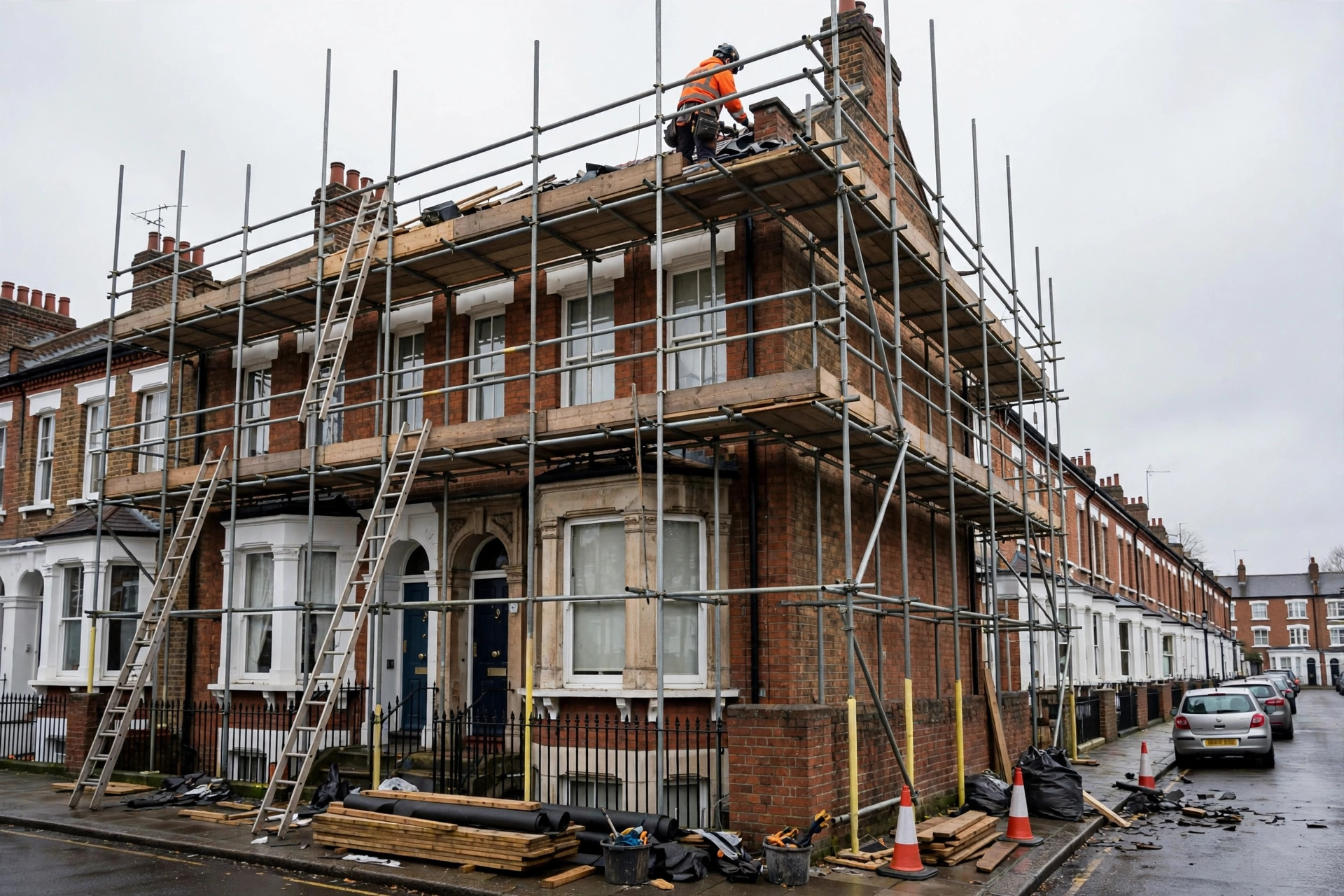
Ask three roofers for a quote and you’ll get three different numbers — and scaffolding is often the reason. In London, access is one of the biggest line items on any roofing job, and understanding what it should cost stops you from either overpaying or accepting a quote that’s suspiciously cheap because the “scaffolder” is a mate with ladders.
Typical scaffolding costs for roof work in London 2026
Realistic 2026 hire prices for standard independent scaffolds (both sides, with boards and ladders), erected and dismantled by a proper scaffolding firm:
- Single chimney stack or small repair (tower or single lift): £400–£900
- Front or rear of a terraced house: £1,200–£2,200
- Full perimeter of a terraced house: £1,800–£3,000
- Full perimeter of a semi-detached house: £2,200–£3,800
- Detached house, full perimeter: £3,000–£5,500
- Complex roofs, three storeys or difficult access: £4,000–£7,000+
These are hire costs for the duration of a typical roofing job (2–4 weeks). Longer hires cost more per week after the initial period — usually £150–£400 per week extra depending on size.
What drives scaffolding costs up?
Height and storeys. A bungalow scaffold is a day’s work; a three-storey Victorian terrace needs more lifts, more tubes and more time. Every extra lift adds cost.
Access. Narrow side passages, no rear access, basement areas that need bridging — London terraces are full of these. If the scaffold has to be carried through the house or bridged over an extension, the price climbs.
Pavement licences. If any part of the scaffold sits on the pavement or road, the scaffolder needs a licence from the council — in London that’s typically £150–£400, plus the cost of any parking bay suspensions (£50–£80 per day per bay in many boroughs). A reputable firm arranges this; a cheap one “forgets” and leaves you liable.
Duration. Scaffolding is usually priced for a set hire period. If your roofing job overruns, the weekly extension charges kick in. This is one reason to choose a roofer who finishes on schedule.
Special requirements. Bridging over conservatories, loading bays for materials, debris netting, edge protection for flat roofs — all add to the bill.
Scaffold vs tower vs cherry picker
Not every job needs a full scaffold:
Mobile towers suit small, short jobs — a chimney repoint, a chimney repair, a single flashing. They’re quicker to set up and much cheaper (£150–£400 per week hire), but they’re only safe on firm, level ground and for light work.
Full scaffolds are needed for re-roofs, long gutter runs and anything where roofers need to work across the whole elevation for days. They’re the only option for most roof repairs on upper storeys.
Cherry pickers (MEWPs) occasionally make sense for inspections or single-day jobs, but they’re expensive per day in London and need road space — rarely the cheapest option for roofing.
Who arranges the scaffolding — you or the roofer?
Usually the roofer. Most roofing firms either have their own scaffolders or a regular subcontractor, and folding it into one quote means one point of responsibility. If you’re arranging it yourself, get the scaffold specification from the roofer first — wrong-height lifts or missing loading bays will cost you more to fix than the saving was worth.
Be wary of any roofing quote that doesn’t mention access at all. Roofers don’t work off ladders for multi-day jobs anymore — health and safety rules require proper edge protection — so a quote with no access provision is either incomplete or the work is being done unsafely. This is a classic red flag covered in our guide to cowboy roofer warning signs.
Why scaffolding makes small jobs expensive
One of the most common frustrations we hear: “It’s a ten-minute job, why does it cost hundreds?” A slipped tile sitting in the gutter can take minutes to refix, but getting a roofer safely to it on a three-storey terrace means a tower or scaffold, and that’s where the money goes. It’s not the roofer padding the bill — it’s the access. If several small jobs can be batched (that slipped tile, the mossy gutter, the suspect flashing), one access cost covers them all.
How scaffolding affects your roofing quote
When roofing quotes vary wildly, check the access arrangements first. One quote includes a full scaffold with pavement licence; another assumes ladders and a prayer; a third expects you to arrange the scaffold yourself. These aren’t comparable quotes — they’re different jobs. Always ask each roofer to state their access plan in writing.
How long does scaffolding stay up?
For a typical re-roof: 2–4 weeks. For a chimney job: 3–7 days. For a repair: a few days. Agree the expected duration upfront, and ask what happens if the job overruns — who pays the extension charges matters. While it’s up, keep the area underneath clear and give your neighbours a heads-up; most scaffolders will fit ladder guards and debris netting if you ask, which keeps the site tidy and secure.
Get a free, no-obligation quote
Our quotes always include proper, safe access — specified in writing, with licences arranged where needed. We’re a family-run roofing contractor working across Camden and all of London, open 24 hours. Request a free quote and you’ll know exactly what the access costs and why — no hidden extras, no surprises.