If you’re re-roofing a house in London, this is the choice you’ll likely face: natural slate or concrete tiles. They’re the two dominant pitched roof coverings in the UK, and they suit different houses, budgets, and priorities.
We’ve laid both for decades. Here’s how slate vs concrete tiles compare on the things that actually matter.
Cost: the biggest difference
Let’s get this out of the way first, because it decides the question for many people.
- Concrete tiles: £8,000–£14,000 for a full re-roof on a typical 3-bed semi in London (2026 bands).
- Natural slate: £12,000–£22,000+ for the same house — roughly 40–70% more, depending on the slate’s origin and the roof’s complexity.
Why the gap? Slate itself costs more per square metre, it’s heavier to handle, slower to lay (each slate is individually holed and fixed), and it demands a more skilled fixer. Concrete tiles are faster, more forgiving, and the materials are cheaper.
If budget is the deciding factor, concrete wins outright. There’s no shame in that — it’s the rational choice for most homes.
Lifespan: slate wins by a mile
- Natural slate: 80–150 years. Good Welsh slate can outlast the building’s other components several times over.
- Concrete tiles: 40–60 years for the tiles themselves — though as we explain in how long a roof lasts in the UK, the underlay usually calls time first.
Over a century of ownership, a slate roof might be laid once; a concrete tile roof might be laid twice. That narrows the lifetime cost gap considerably — though “lifetime cost” is cold comfort when you’re writing the cheque today.
Weight: a structural consideration
Concrete tiles are heavy — roughly twice the weight of slate per square metre. Most houses built for concrete tiles handle it fine, but you can’t always swap freely:
- Slate → concrete: usually needs a structural check. The roof was designed for a lighter covering, and doubling the load isn’t something to guess at.
- Concrete → slate: almost always fine structurally (you’re reducing load), and it’s a common upgrade.
If your roof currently has slate and you’re considering concrete to save money, get the structure assessed first. The saving evaporates if you need structural work.
Looks: character vs uniformity
This is subjective, but it matters — you’ll look at it every day, and so will future buyers.
Slate has natural variation in tone and texture that gives a roof depth and character. On period properties — Victorian and Edwardian terraces, which is half of inner London — slate looks right. It’s also what conservation areas and listed-building officers usually want to see.
Concrete tiles are uniform and tidy. Modern profiles can look sharp on newer houses, and the colour range is wider (greys, browns, reds). But on a period property, concrete tiles can look flat and out of place — estate agents will tell you slate holds kerb appeal better on character homes.
Maintenance and repairs
Both need the same basic maintenance: gutters cleared, slipped units replaced, ridges and flashings kept sound. Differences:
- Slate repairs need a skilled slater — it’s a craft, and a bad slate repair is obvious. Individual slates are cheap; the skill is the cost.
- Concrete tiles are easier to repair and replace, and any competent roofer can do it. Replacement tiles are cheap and widely available.
Moss is more of an issue on concrete tiles — their rougher, more porous surface holds moisture and moss takes hold readily. Slate’s smooth surface sheds moss better (though it still grows in damp, shaded spots).
Weather performance
Both handle UK weather well when properly laid. Slate’s thin profile and tight laying shed water efficiently; concrete tiles rely on their interlocking design and headlap. In exposed locations, both need correct fixing — nails, clips, and headlap to spec, not shortcut.
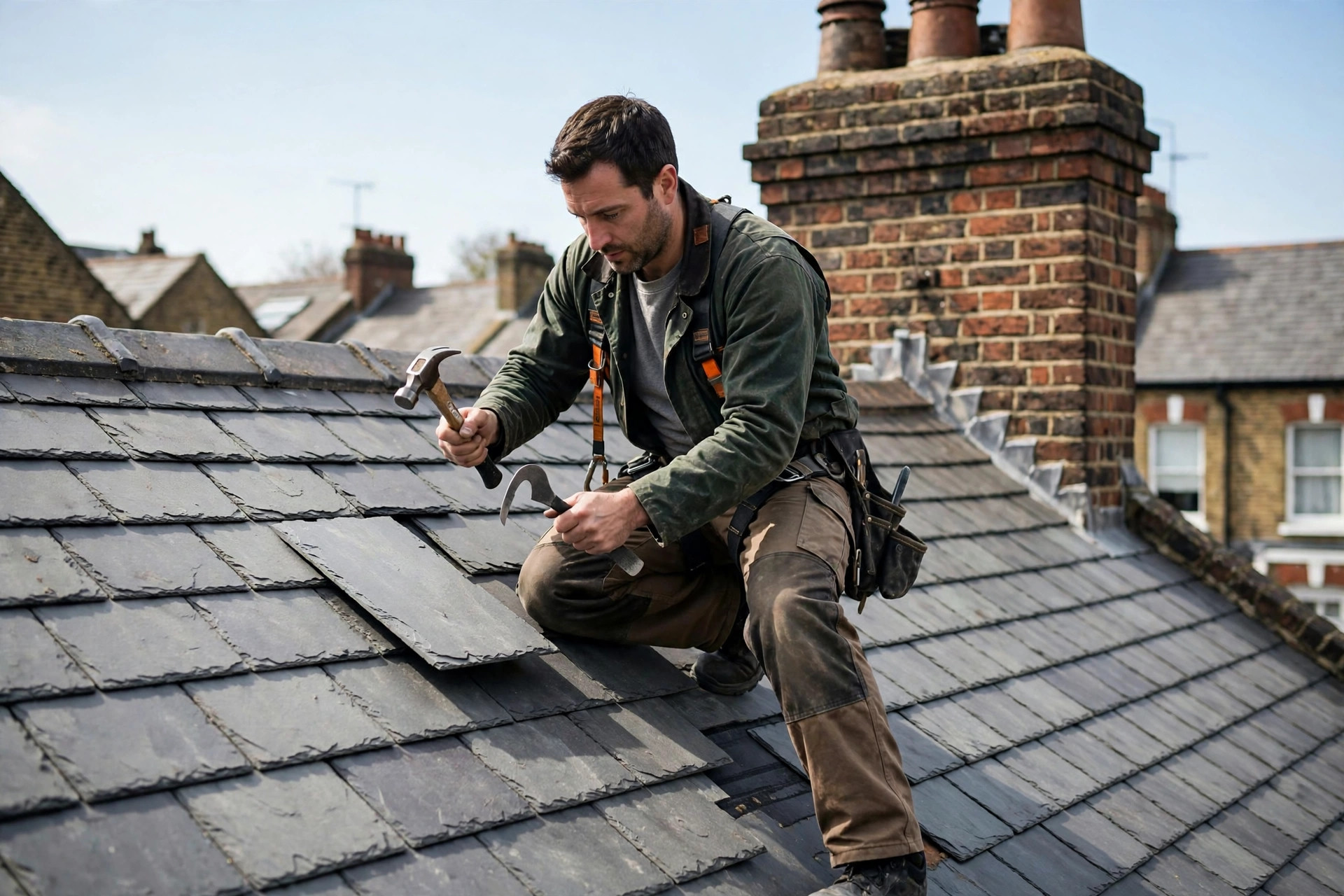
One practical note: slate is more brittle underfoot. If anyone works on your slate roof — aerial installers, solar panel fitters — they need to know what they’re doing, or you’ll be paying for cracked slates.
So which is best?
Choose slate if: you have a period property, you’re in a conservation area, you’re staying long-term, and the budget stretches. It’s the once-in-a-lifetime roof.
Choose concrete tiles if: budget matters most, the house is modern or already tiled in concrete, or you’re selling within a few years and need a sound, tidy, guaranteed roof without the premium.
Either way, the covering is only half the roof. New breathable membrane, treated battens, correct fixings, and sound ridges, valleys, and flashings matter just as much — a badly laid slate roof will leak before a well-laid concrete one. Choose the roofer as carefully as the material: our questions to ask a roofer guide helps.
One more practical point: a like-for-like re-roof rarely needs planning permission, but switching materials — especially in a conservation area — sometimes does. Parts of Camden carry Article 4 directions that restrict even minor external changes, so check with the council before committing to a material swap.
Re-roofing in London? Let’s talk
Victoria Roofing Expert Ltd — 188 Camden High St, London NW1 8QP, 07848 256099. Family-run since 1982, 5.0 from 338 Google reviews, open 24 hours. We lay both slate and concrete tile roofs across Camden and all of London, and we’ll give you honest advice on which suits your house and budget. Workmanship fully guaranteed.
See our roof installation in London page, or get a free quote — no obligation.