
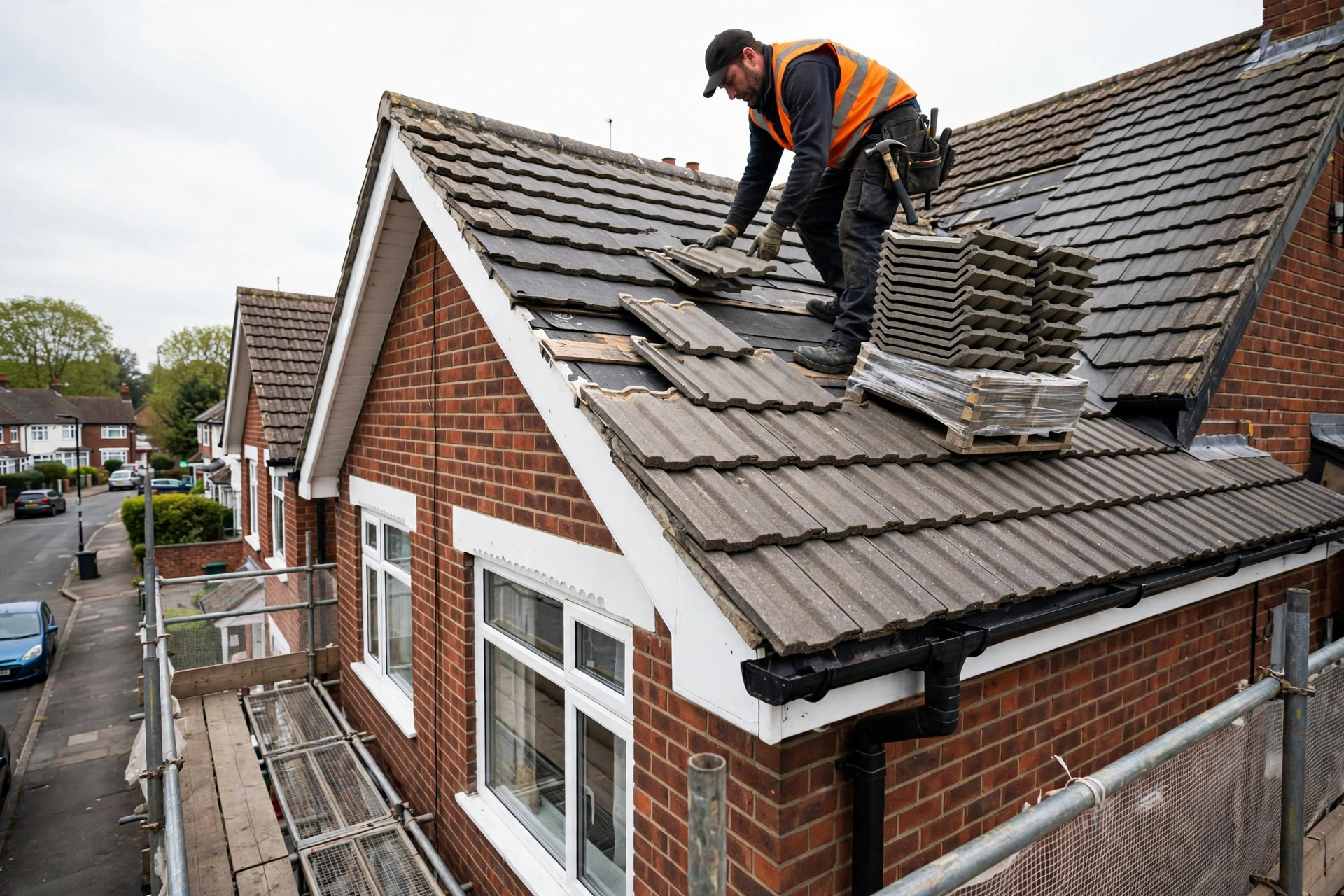
It’s the question behind half the calls we get: “Can this be repaired, or does it need replacing?” Some roofers answer “replace” to everything — it’s the bigger job. Others will patch anything, leaving you paying for repairs every year on a roof that’s done.
Here’s the honest framework we use on surveys across London. No sales pitch — just how to think about it.
Start with the roof’s age vs its expected lifespan
This is the single most useful piece of context. A 15-year-old concrete tile roof with a slipped tile is a repair — it’s got decades left. A 55-year-old concrete tile roof with perished underlay and leaks in three places is a replacement wearing a repair’s clothes.
Rough guide to where “repair” stops making sense:
- Felt flat roof over 20 years old with multiple issues → replace
- Concrete tile roof over 45–50 years with original underlay → start planning replacement
- Slate roof: age matters less than condition — slates last a century, but fixings and battens don’t. Assess, don’t assume.
If you don’t know your roof’s age or covering lifespan, our how long does a roof last in the UK guide has the full breakdown.
The extent test: localised or systemic?
Repair it when the problem is localised and the rest of the roof is sound: a slipped tile, a failed flashing around one chimney, a small patch of damaged felt, a leaking valley on an otherwise healthy roof. These are discrete faults with discrete fixes.
Replace it when problems are systemic — spread across the roof, or symptoms of a failed layer underneath:
- Leaks in multiple, unconnected places
- Widespread slipped, cracked, or spalling tiles
- Underlay that’s perished across large areas (visible in the loft as torn, brittle felt)
- Battens that crumble when touched
- A roof that’s been “repaired” three times in five years and still leaks
A useful rule: one leak is an incident; three leaks is a pattern. Patterns mean the system is failing, and systems get replaced, not patched.
The money maths: when repair stops being cheaper
Get both numbers — a proper repair quote and a replacement quote — then do honest maths:
- A typical localised repair in London: £300–£1,200 depending on the fault and access.
- A full re-roof on a standard 3-bed semi: £8,000–£16,000 in London (2026 bands), more for slate or complex roofs.
Our rule of thumb: if the repair costs more than about a third of replacement, or if you’re facing a second significant repair within a few years, replacement is usually the better value. There’s also the hidden cost of repeated repairs — each one means more scaffolding, more disruption, and more interior damage risk while you wait.
And think about what’s not in the repair quote. A £600 flashing repair on a 50-year-old roof doesn’t buy you a sound roof — it buys you a sound flashing on a roof that will need £12,000 of work within a few years anyway. Sometimes the honest advice is to put the £600 toward the replacement fund.
Five questions to ask before you decide
- What’s the condition of the underlay and battens? This is the question that decides most cases. Sound underlay + localised tile damage = repair. Perished underlay = the clock is ticking regardless.
- Is the structure sound? Sagging, rotten rafters, or spread — structural issues change the conversation entirely. Get these assessed properly.
- How long are you staying? Selling next year? A competent repair that gets you through the sale is rational. Staying twenty years? Invest in the replacement and stop thinking about it.
- What will the next five years cost either way? Add up likely repairs (ask the roofer candidly) versus one replacement. Be pessimistic about the repair path — roofs don’t improve with age.
- Are there regulations to consider? Replacing more than 25% of a roof triggers building regulations thermal requirements — which usually means upgrading insulation at the same time. That’s a cost, but it’s also a genuine improvement to comfort and bills.
Watch out for these red flags
- “It definitely needs a whole new roof” — from a roofer who spent four minutes looking at it from the pavement. Get a second opinion.
- “We can just felt over the top” — overlaying a failing pitched roof covering without addressing the underlay is hiding the problem, not fixing it.
- A repair quote with no diagnosis — “£800 to fix the leak” without explaining where the water’s getting in and why is a guess, not a quote.
- Pressure to decide today — a roof that’s lasted 40 years can wait a week while you get another quote. For guidance on vetting roofers, see questions to ask a roofer and cowboy roofer warning signs.
The scenario we see most
The most common situation: a 1960s–70s concrete tile roof, original felt underlay now perished, a few slipped tiles, maybe a valley starting to go. The homeowner has had two or three repairs over the years. Each repair was reasonable on its own — but the roof is telling them it’s done.
In that scenario we usually recommend replacement: strip, new breathable membrane, treated battens, re-lay the sound tiles (or new ones), new ridges, valleys, and flashings. It’s a bigger bill once, instead of a smaller bill forever — and you get a roof with a 40+ year horizon and fully guaranteed workmanship.
Get an honest assessment
Victoria Roofing Expert Ltd — 188 Camden High St, London NW1 8QP, 07848 256099. Family-run since 1982, 5.0 from 338 Google reviews, open 24 hours. We’ll survey your roof properly — covering, underlay, battens, structure — and tell you straight whether it wants a repair or a replacement. If it’s a repair, we’ll say so.
See roof repair in London or roof installation in London, or get a free quote — no obligation, no pressure.