
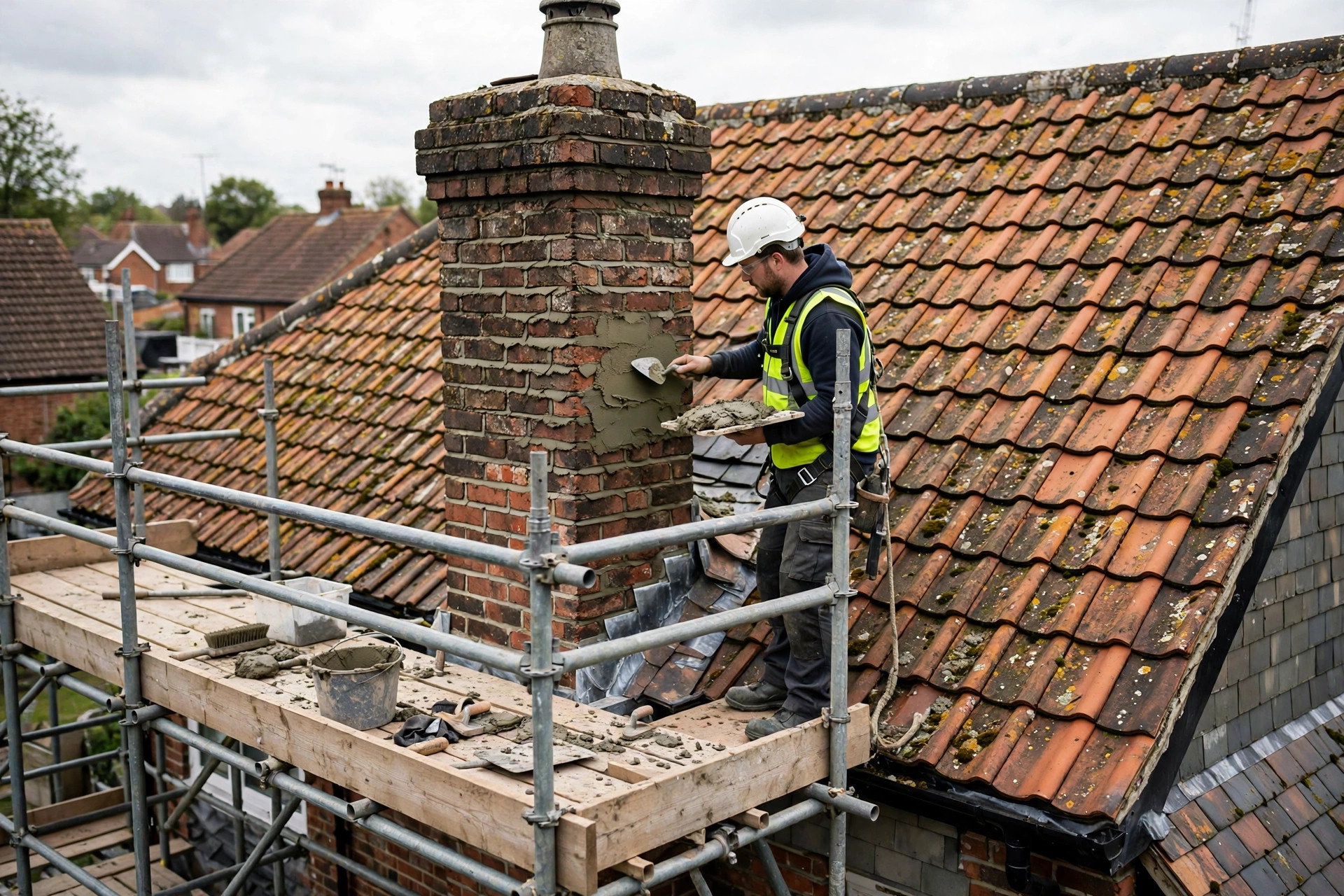
Few chimney conversations end at a simple repair quote. On a lot of London’s Victorian and Edwardian terraces, the stacks are disused — the fireplaces were bricked up decades ago — yet the stacks still sit on the roof, soaking up rain and needing maintenance. So when a stack starts causing trouble, the question comes up: is it worth repairing, or should you just take it down? Here’s how to think it through, with realistic London costs for both.
Why chimney stacks become a problem
A chimney stack is a tall, thin structure made of brick and mortar, standing fully exposed to the weather. Over a century, that takes its toll:
- Mortar joints erode, letting water into the stack and loosening the brickwork
- Bricks spall (faces flake off) from freeze-thaw damage
- The flaunching — the mortar cap at the top — cracks, letting rain straight into the flue
- Flashing fails where the stack meets the roof, causing leaks (see our guide to a chimney flashing leak)
A stack in this condition isn’t just a maintenance burden; a genuinely unstable stack is a hazard. Loose bricks or a leaning stack can shed masonry onto the roof or the street below.
Repair: what it involves and what it costs
Repair makes sense when the stack is fundamentally sound — the brickwork is mostly good, the stack is straight, and the issues are mortar, flaunching, or flashing.
Typical repairs and 2026 London price bands:
- Repointing the stack: £600–£1,500 depending on height and access (our full breakdown is in chimney repointing cost in London)
- New flaunching (top cap): £250–£500
- Renewing the lead flashing: £750–£1,500
- Full refurbishment (repoint + flaunching + flashing): £1,500–£3,000
Repairs keep the stack standing and weathertight for decades. If you still use the fireplace, or the flue serves a boiler or gas fire, repair is usually the right answer — a working flue needs its stack. For a full rundown of chimney services, see chimney repair in London.
Removal: what it involves and what it costs
Removal means taking the stack down to below the roofline, then making the roof good: the hole is decked over, felted, tiled or slated to match, and the loft side is sealed and insulated. Done properly, you’d never know the stack was there.
Typical 2026 London price bands:
- Partial removal (stack down to roof level, roof made good): £1,000–£2,000
- Full removal (stack removed from the loft down as well, freeing the chimney breast): £2,000–£4,000, rising with structural work
A full internal removal is a bigger project: the chimney breast brickwork comes out room by room, and steel supports (gallows brackets or beams) are needed where the remaining stack above is supported. That needs a structural engineer’s input and usually building control sign-off.
The considerations most people miss
Party-wall rules. On terraced and semi-detached houses, the chimney stack is often shared with your neighbour — it sits on the party wall. Removing or altering a party-wall stack triggers the Party Wall Act: you must serve notice, and if your neighbour dissents, you’ll need a party wall award (surveyor costs typically £700–£1,500 per side). We’ve seen straightforward removals stall for months on this. Talk to your neighbour early.
The flue question. Before removing anything, establish what the flue serves. Disused fireplaces are simple. But some stacks vent gas boilers, and removing the flue means relocating the boiler’s flue terminal — a job for a Gas Safe engineer, not a roofer. Never cap or remove a stack that’s still in use.
Ventilation. A disused flue still ventilates the chimney void. If you remove the stack, the remaining flue must be properly vented at top and bottom, or you’ll get condensation and damp in the sealed void.
Planning and conservation areas. In conservation areas — and Camden has plenty — removing a chimney stack can need planning permission, because stacks are part of the protected streetscape. Check with the council before booking the work.
Resale and character. On a period property, original chimney stacks are part of its character. Estate agents in areas like Camden, Islington, and Highgate will tell you that a terrace stripped of its stacks looks wrong to buyers. Repair preserves the look; removal changes it permanently.
So which is it — repair or remove?
As a rule of thumb:
- Repair if the stack is straight and the brickwork is mostly sound, if any flue is still in use, if the stack is shared and your neighbour won’t agree to removal, or if you’re in a conservation area.
- Remove (down to roof level) if the stack is disused, structurally poor, and the cost of a full rebuild approaches or exceeds the removal price.
- Rebuild if the stack is leaning or the brickwork is shot but you want to keep the look — a rebuild costs roughly £1,500–£3,500 per stack.
If you’re weighing a bigger roofing project at the same time, stack work is cheapest when scaffolding is already up for a new roof installation — ask for a combined quote.
Get advice before you decide
This is one of those decisions where a proper on-roof inspection pays for itself. Victoria Roofing Expert Ltd is a family-run roofing contractor at 188 Camden High St, London NW1 8QP, working across Camden and all of London since 1982. We’ll inspect your stack, tell you honestly whether repair or removal makes more sense, and flag the party-wall and flue issues before you commit. Fully guaranteed workmanship, 5.0 from 338 Google reviews.
Call 07848 256099 — we’re open 24 hours — or get a free quote through our contact page.