
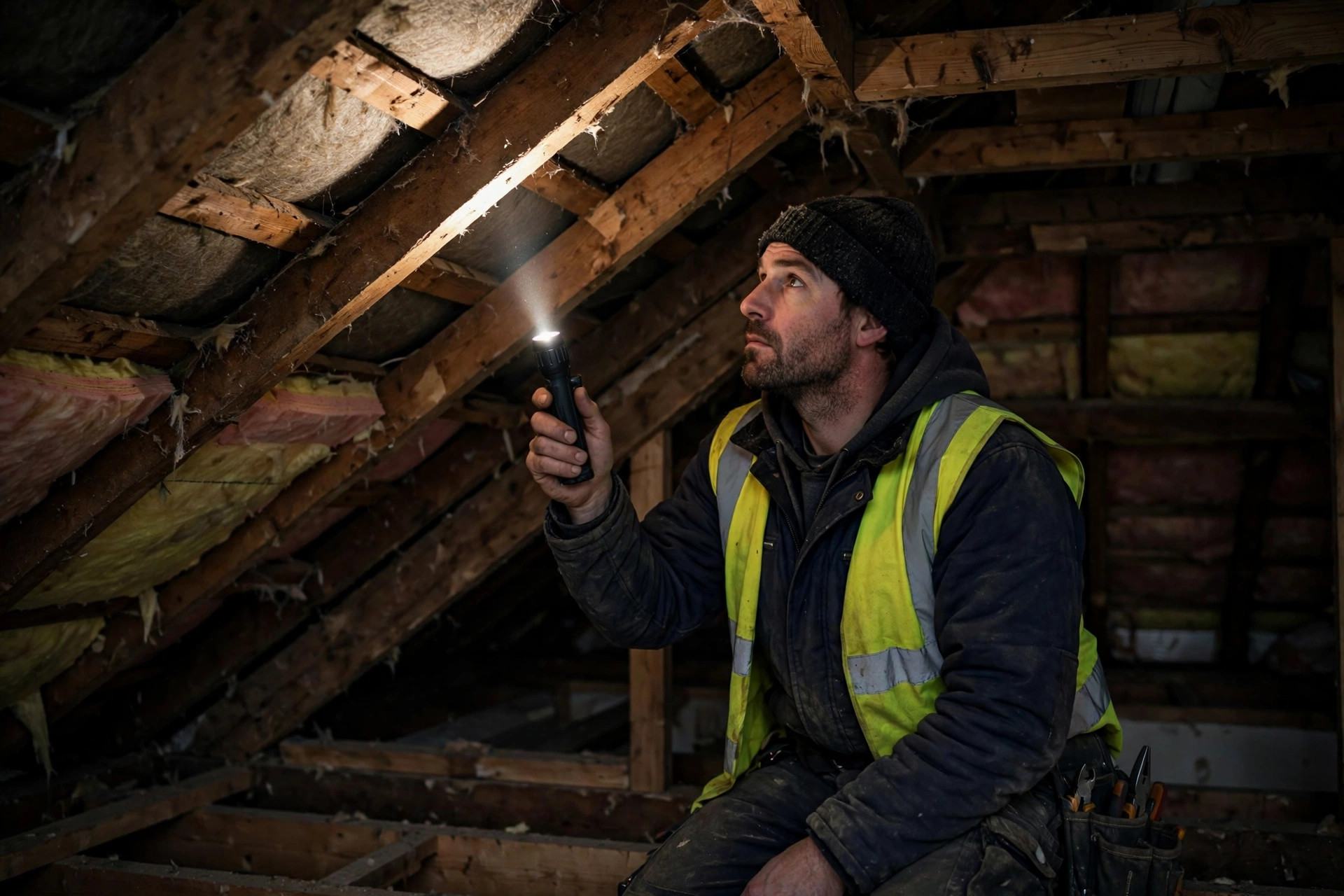
You go up into the loft and find damp. Wet timbers, water droplets on the felt, maybe mould spots or a damp patch on the insulation. Your first thought is the obvious one: the roof is leaking.
But very often it is condensation — warm, moist air from the house turning to water on cold loft surfaces. The two look similar but have different causes and fixes: calling a roofer for condensation wastes money, while ignoring a real leak costs far more.
Here is how to tell which one you are dealing with.
Why the confusion happens
Both cause the same visible symptom — wetness in the loft — and both are worst in cold, wet winter months, when rain is heaviest and the house-to-loft temperature difference is greatest. By the time you notice, the source can be hard to trace.
The fixes are opposites: a leak needs roof repair — flashing, tiles, joints — while condensation needs better ventilation and warm air kept out of the loft. Fix the wrong one and you spend money without solving anything.
Signs it is condensation
Condensation has a distinctive pattern. Look for these clues:
Widespread, uniform dampness. Condensation tends to affect large areas evenly — droplets across the whole underside of the felt, general dampness on timbers throughout the loft. A leak is usually localised to one spot.
Worst on the coldest surfaces. Water beads on the underside of the roofing felt, on nails protruding through the felt (look for rusty nail tips with droplets), and on any cold water tanks or pipes. These are the coldest surfaces, which is exactly where condensation forms first.
Timing follows the weather and the heating. Condensation is worst on cold, still nights when the heating is on and the loft is at its coldest relative to the house. If the dampness appears and disappears with cold snaps rather than with rain, that points to condensation.
No wetness during rain (at first). This is the key test: check the loft during or immediately after heavy rain. If everything is dry during the rain but damp on cold dry mornings, it is condensation.
Mould and musty smell. Surface mould on timbers and a musty smell are classic condensation signs. A leak tends to produce more localised staining and rot.
Bathroom or kitchen below. If the damp area is above a bathroom or kitchen — the two rooms that produce the most moisture — condensation becomes the prime suspect. Warm moist air rises through gaps around pipes, light fittings and the loft hatch.
Signs it is a roof leak
A genuine leak behaves differently:
Localised wetness. One damp patch, one stained area, one drip — while the rest of the loft is dry. Water entering through a failed tile or flashing follows a path; it does not spread evenly.
Wet during or after rain. The defining test. If the loft is wet when it is raining (or in the hours after), and dries out in dry spells regardless of temperature, water is coming through the roof covering.
Staining and tidemarks. Leaks leave brownish stains and tidemarks on timbers, felt and insulation as water repeatedly follows the same path and dries. Condensation rarely leaves tidemarks — it wets everything lightly and evenly.
Damp insulation in one spot. A single soaked patch of loft insulation, especially with a drip point above it, is a leak until proven otherwise.
Daylight visible. If you can see daylight through the roof covering (turn the loft light off and look), you have found at least one entry point. Note that some daylight at eaves and ridges can be normal ventilation — but daylight through the middle of a slope is not.
Wetness on the top side of the felt. Condensation forms on the underside of the felt (the loft-facing side). If the top side is wet or the felt is damaged, water is getting past the tiles.
The simple diagnostic tests
The rain test. Check the loft during heavy rain or within an hour after it stops. Wet = likely leak. Dry during rain but damp on cold mornings = likely condensation. This single test resolves most cases.
The tissue test. On a dry day, tape dry tissue or kitchen roll to suspect areas — timbers, felt, around the chimney. Check after the next cold night and after the next rain. Tissues that are damp after cold nights but dry after rain point to condensation; the reverse points to a leak.
The hose test (use with care). Have someone gently run a hose over the suspect roof section while you watch from inside, starting low and working up. If water appears, you have found the entry point. Never do this alone.
Check the basics first. Before assuming either: is the loft hatch sealed? Are bathroom extractor fans venting into the loft instead of outside (extremely common and a massive condensation cause)? Is there any ventilation at all — soffit vents, tile vents? These checks are free and often reveal the answer.
What to do about condensation
For condensation, manage moisture and airflow — not the roof covering:
- Ventilate the loft properly. Soffit vents, tile vents or ridge ventilation that allows a through-flow of air. Our loft ventilation guide covers exactly what UK homes need.
- Stop warm air getting up there. Seal gaps around the loft hatch, pipe penetrations, downlights and wiring. Fit a draught-sealed insulated loft hatch.
- Vent bathrooms and kitchens outside. Extractor fans must duct to the outside air, not into the loft space. This single fix resolves a huge proportion of loft condensation cases.
- Do not block the eaves. Loft insulation pushed tight into the eaves blocks the airflow from soffit vents. Keep a clear air path.
What to do about a leak
A leak needs a roofer — sooner rather than later, since loft water rots timbers and ruins insulation. Note where the wetness is (take photos) and whether wind-driven rain from one direction makes it worse; it helps the roofer find it faster.
Common leak sources include slipped or broken tiles, failed flashing around chimneys and valleys, and perished felt at the eaves. Our guide to what to do when your roof is leaking in heavy rain covers the immediate steps. For professional diagnosis and repair, see our roof repair services in London.
When to call a professional
Call a roofer if the rain test points to a leak, if you can see daylight through the roof slope, if timbers are soft or rotting, or if you simply cannot tell and want a definitive answer. A proper inspection is quick and inexpensive compared with the cost of guessing wrong.
Victoria Roofing Expert Ltd diagnoses loft damp across Camden and all of London — and will tell you honestly if it is condensation, because there is no point selling a repair you do not need. Family-run since 1982, 5.0 from 338 Google reviews, open 24 hours. Get a free quote.