
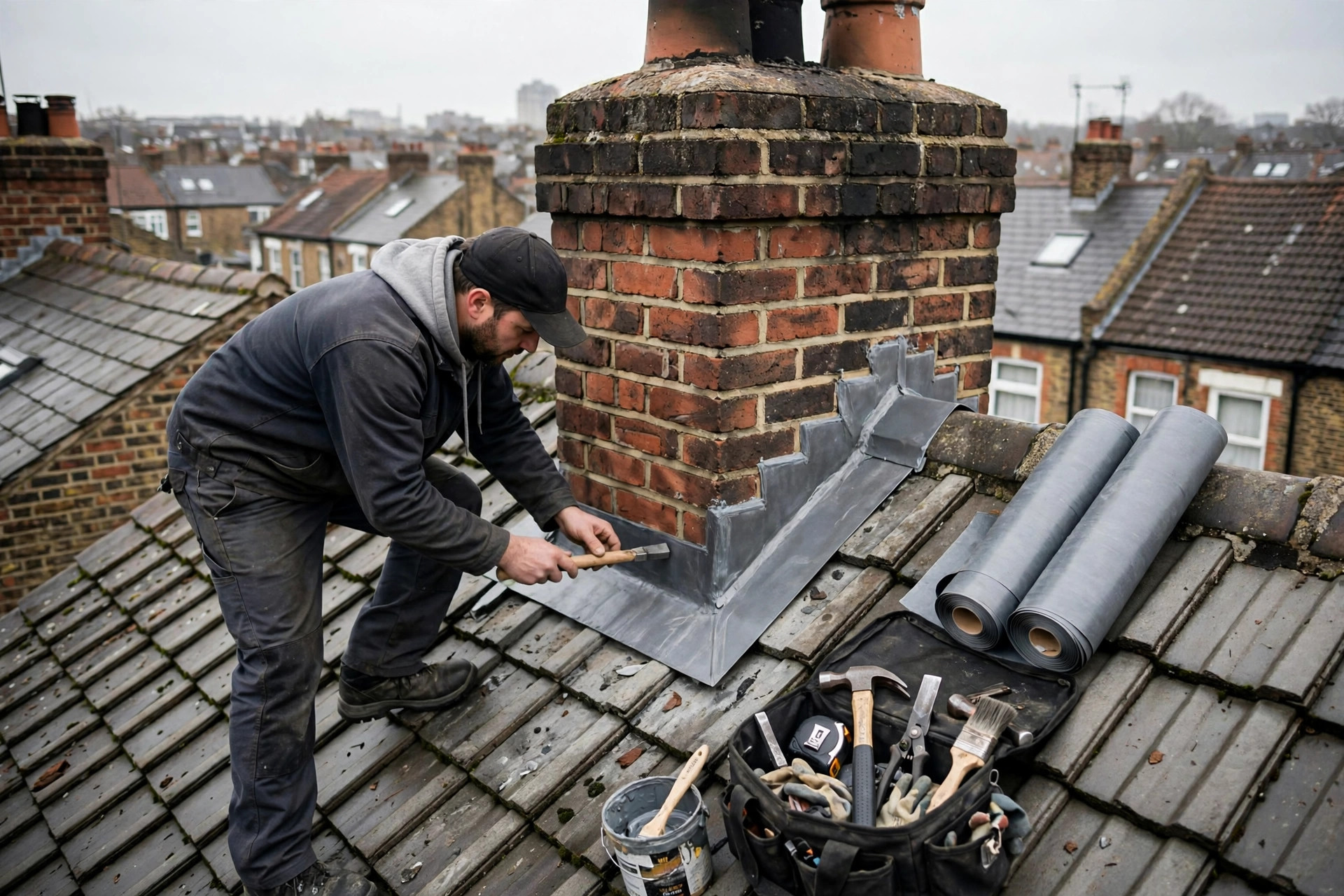
Lead flashing is the waterproof seal where your roof meets a chimney, a wall or a valley — and it’s behind more leaks than any other single component. When it cracks, splits or lifts, water has a direct path inside. The good news: renewing it is usually a day’s work and far cheaper than most people expect. Here’s the 2026 picture.
How much does lead flashing replacement cost in the UK?
Realistic 2026 price bands, fitted by a roofer:
- Chimney flashing (front, back and step flashing, both sides): £700–£1,400
- Single abutment flashing (where a roof meets a wall): £350–£700
- Valley lead renewal (per valley): £800–£1,600
- Small flashing repair (patch or re-seal): £150–£350
London prices sit at the upper end. Access is the biggest variable — a chimney flashing on a two-storey terrace with an existing scaffold can be done cheaply; the same job needing a fresh scaffold erection costs considerably more.
Why lead flashing fails
Lead is an excellent material — it lasts 60–100 years when fitted properly. It fails early for specific reasons:
Thermal movement. Lead expands and contracts. If it’s fitted in bays that are too long, or nailed too rigidly, it fatigue-cracks. You’ll see splits along the bend lines.
Poor installation. Flashing that’s just laid on top of tiles without proper soakers, or sealed with mastic instead of being dressed and tucked into the mortar joint, fails quickly. One of the most common homeowner questions we hear is whether flashing should follow the tile contours — yes, properly dressed lead follows the profile of the tiles.
Age and acid rain. Old lead thins over decades. On very old properties, the flashing may simply be worn out.
Disturbed by other work. Builders and satellite-dish installers leaning on flashings is a classic cause of lifted lead.
How to spot a failing flashing
- Water staining on the chimney breast or the wall below an abutment, especially after wind-driven rain
- Visible splits, cracks or lifted edges in the lead — binoculars from the garden help
- Damp patches in the loft where a valley or flashing meets the roof slope
- Daylight visible around the chimney in the loft (never a good sign)
If your chimney is leaking, the flashing is the first suspect — before the pointing or the flaunching.
What’s involved in a proper replacement?
A proper lead flashing renewal means:
- Stripping the old lead and cleaning out the mortar joints
- Fitting new Code 4 or Code 5 lead (the right thickness for the location), cut into bays of the correct length
- Dressing the lead properly over the tiles with soakers underneath
- Raking the lead into the brickwork joint and pointing it in — never just surface-sealed with mastic
- Replacing the soakers, not re-using the old ones
The whole chimney job typically takes a day. A single abutment or small valley might be half a day. Done well, new lead flashing is a fit-and-forget job — it should outlast the roof covering around it.
Repair vs replacement
Small, localised damage — one split bay, a lifted corner — can often be repaired for £150–£350 if the rest of the lead is sound. But if the flashing is old throughout, patching one bay usually means you’ll be back for the next bay within a year or two. On a chimney that’s already having repointing done, renewing the flashing at the same time is the obvious move — the access is already paid for.
Similarly, if the lead in a valley is failing, the tiles around it are usually disturbed during the work, so expect some making-good. Our guide to roof valley leak repair covers what’s involved.
Lead prices and why quotes vary
Lead is a commodity — its price moves with the market — and it makes up a meaningful chunk of the materials cost. Code 4 lead (for flashings) and Code 5 (for valleys and gutters) are priced by weight. Quotes can also vary because some roofers price the scaffold separately, some include it, and some will fold a small flashing job into a larger roof repair visit. Always ask what’s included.
Beware the mastic bodge
If a quote offers to “seal” failed flashing with mastic or flashing tape instead of replacing the lead, treat it as a temporary repair, not a fix. These products buy you a season or two at best. On a chimney, a proper lead renewal done well will outlast most of us — it’s worth doing once and doing right. This is also a classic cowboy roofer tell: the quick smear of sealant instead of the day’s work the job actually needs.
Getting a fair quote
Ask for: the lead code (thickness), whether soakers are being replaced, how the lead is fixed into the brickwork, what’s included for access, and the guarantee. A written quote that names these details is the mark of a roofer who actually does this work properly. And compare like with like — a quote that includes the scaffold and one that doesn’t aren’t competing on the same job.
Get a free, no-obligation quote
Chimney and valley flashings are bread-and-butter work for us — we renew them across Camden and all of London, usually in a single day. See our chimney repair service, or request a free quote from our family-run team (trading since 1982, 338 five-star Google reviews) — no pressure, no obligation.