
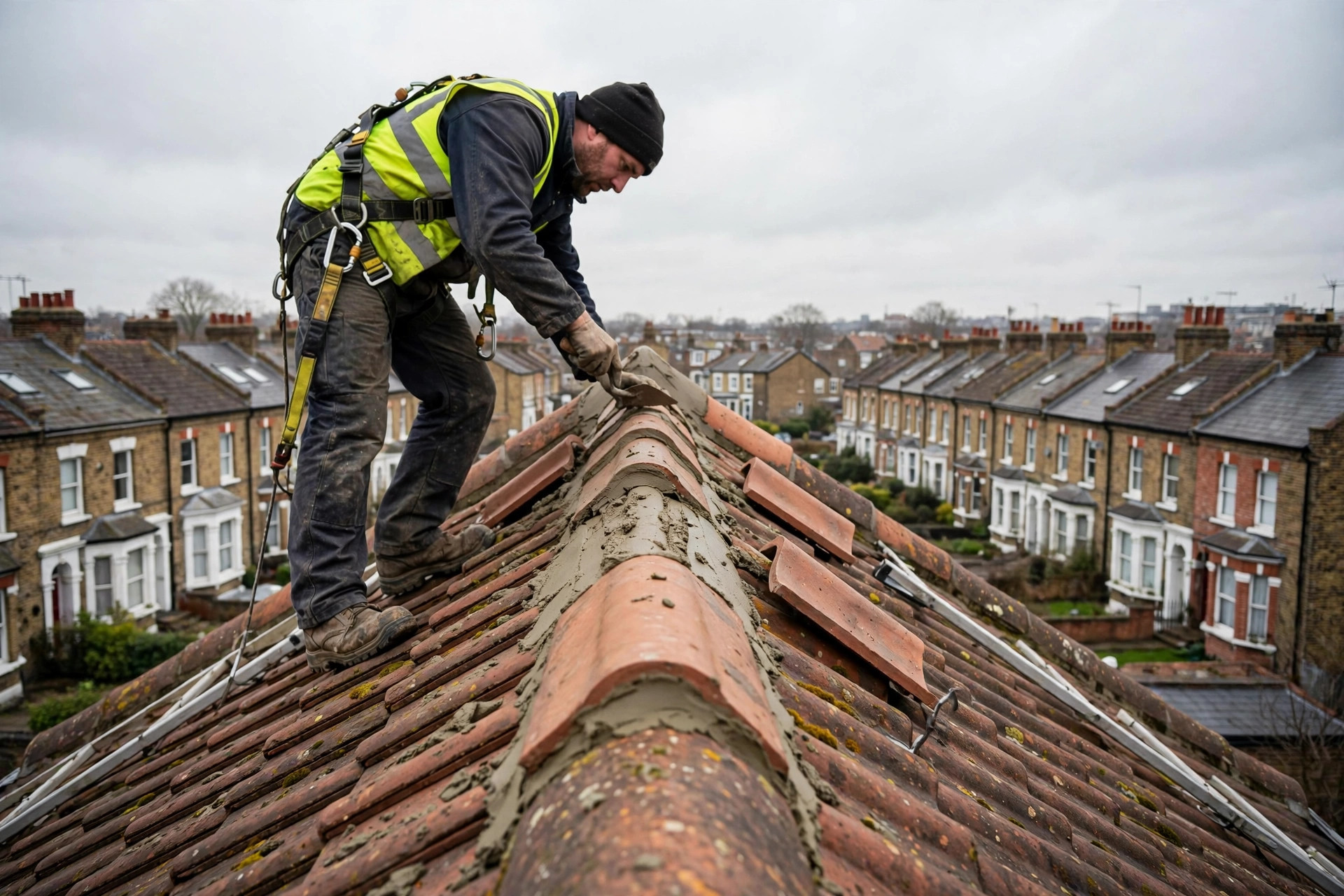
Look along the very top of any pitched roof and you’ll see a line of half-round tiles or caps running the length of the apex. Those are your ridge tiles, and they do one of the most important jobs on the roof: they seal the joint where the two slopes meet, keeping wind and rain out of the ridge line. Because they sit at the most exposed point of the roof, they’re also among the first components to work loose. If you’ve spotted a ridge tile that’s slipped, cracked, or missing altogether, here’s what causes it, why it matters, and what a repair will cost in London.
What causes ridge tiles to slip?
Most ridge tiles in older London housing are bedded on mortar. That mortar — sometimes original lime mortar on Victorian and Edwardian terraces — has a hard working life: baking sun, hard frosts, and wind-driven rain, year after year. Over decades it crumbles and loosens its grip, and the tile starts to rock.
A few specific causes we see regularly:
- Aged mortar bedding. After 30–50 years the mortar joints simply deteriorate. This is the single most common reason ridge tiles loosen on period terraces across Camden and North London.
- Freeze-thaw cycles. Water gets into hairline cracks in the mortar, freezes, expands, and opens the crack a little wider. One hard winter can finish off bedding that was already tired.
- Storm damage. High winds can lift a tile that’s already loose, or dislodge one outright. Gales are the usual culprit when a homeowner suddenly finds a ridge tile missing after a night of bad weather.
- Deteriorated bedding on hip ridges. On hipped roofs the angled ridge tiles (bonnets or hip caps) fail in exactly the same way.
Modern roofs often use a dry ridge system instead of mortar: ridge tiles fixed mechanically to a batten with a ventilated membrane underneath. These need no repointing and are far more storm-resistant, which is worth knowing if you’re paying for a repair anyway.
Why you shouldn’t ignore loose ridge tiles
A slipped ridge tile is not just cosmetic. Once the seal at the apex is broken, wind-driven rain gets straight under the ridge line and onto the roof underlayment. Underlayment is a secondary barrier, not a roof covering — leave it exposed and it will degrade, and water will find its way into the loft.
There’s also a safety angle. Ridge tiles are heavy, and they sit at the top of the roof. In high winds a loose one can be lifted clean off and fall onto a pavement, a garden, or a parked car. If a tile comes down and injures someone, the homeowner’s liability position is an unpleasant one to be in.
Finally, catching it early genuinely saves money: one slipped tile can often be lifted and rebedded, while a whole ridge run with perished mortar needs stripping and re-laying — a bigger, costlier job.
If water is already coming in elsewhere on the roof, see our guide to roof repairs in London for how leaks are tracked and fixed.
Repair options: repointing, rebedding, or replacing
Not every loose ridge tile needs the same treatment. Here’s how a roofer decides:
Repointing (or re-flaunching). If the tiles themselves are sound and mostly seated, but the mortar joints are cracked or missing, the old pointing is raked out and fresh mortar is worked in around each tile. This suits ridges that are fundamentally stable but weathered.
Rebedding. Each tile is lifted off, the old bedding removed, and the tiles laid back on fresh mortar — the proper fix for a loose ridge run.
Full ridge replacement. If the tiles are cracked, spalled, or the wrong profile to re-use, we strip the lot and fit new ridge tiles on fresh bedding — or convert to a modern dry ridge system, which does away with mortar maintenance entirely. Dry ridge conversion is the best long-term option and is now the standard on new builds.
On period roofs, matching profiles and colours matter — a good roofer sources reclaimed or matching new ridges so the repair doesn’t stand out.
Ridge tile repair cost in London (2026)
Prices depend on the length of the ridge, how easy the access is, and whether scaffolding is needed. As a guide, based on typical London work:
- Repointing a ridge run: £300–£600
- Rebedding a ridge run (most common): £500–£1,200
- Replacing ridge tiles with new on mortar: £800–£1,800
- Dry ridge system conversion: £1,000–£2,000
- Scaffolding (if required): £400–£900 extra for a standard terrace
Most jobs take a day; large full replacements can take two. Be wary of quotes that seem far too low — ridge work is mortar work, and proper bedding takes time and skill. Our breakdown of why roofing quotes vary so much explains what to compare when prices differ.
Can you repair ridge tiles yourself?
Honestly, this is not a DIY job. Working at the apex of a roof means working at the highest, most exposed point of the property, usually with no safe footing. Mortar bedding also needs to be mixed and laid correctly to bond and last — a tile bedded on a weak mix will be loose again within a couple of winters. Ridge repairs are a job for a roofer with the right access equipment and experience.
How the repair is done
A typical rebedding job runs like this: access is set up (scaffold or tower, depending on height and roof layout), the loose ridge tiles are lifted off and the old mortar cleared, the ridge line is checked and the underlayment inspected where exposed, fresh mortar is bedded down, and the tiles — original or matching replacements — are laid back on, levelled, and pointed up neatly. We then clear up and check the surrounding roof for any tiles disturbed in the process.
How long will the repair last?
Properly bedded mortar ridge work should last 20–30 years before it needs attention again. A dry ridge system carries no mortar to maintain at all, though the fixings and membrane should still be checked periodically as part of normal roof maintenance. Related issues like leaking valleys are covered in our guide to roof valley leak repair, and if the leak shows up worst in downpours, our article on what to do when your roof leaks in heavy rain will help.
Get your ridge inspected
If you’ve spotted a slipped or cracked ridge tile, don’t leave it to the next storm. Victoria Roofing Expert Ltd is a family-run roofing contractor based at 188 Camden High St, London NW1 8QP, working across Camden and all of London since 1982. We carry out ridge rebedding, repointing, and dry ridge conversions with fully guaranteed workmanship — and with a 5.0 rating from 338 Google reviews, you can check what our customers say before you call.
Call 07848 256099 — we’re open 24 hours — or get a free quote through our contact page for a no-obligation inspection and a written price.